When designing a distribution board or upgrading an electrical panel, installing a Surge Protective Device (SPD) is no longer optional—it is a critical necessity to protect expensive electronics from transient overvoltages. However, one of the most common roadblocks for buyers, electricians, and facility managers is selecting the correct configuration.
Choosing the wrong SPD will not only leave your equipment vulnerable to lightning strikes and switching surges, but it can also create severe fire hazards within your panel. The first and most vital step in the selection process is answering a fundamental question: Do you need a single-phase or a three-phase surge protector?
In this comprehensive engineering guide, we will break down the core differences between single-phase and 3-phase SPDs, explain the critical “pole” configurations (like 1P+N vs. 3P+N), and provide definitive wiring blueprints to help you build a bulletproof distribution board.
Quick Sizing Checklist: Don’t know what you need? Ask yourself two questions:
- Look at the main incoming breaker in your panel. Is it a 2-Pole (often 1 Live + 1 Neutral) or a 4-Pole (3 Live + 1 Neutral) breaker?
- What is your grid voltage? Is it around 220V/230V, or is it 380V/400V? (If 2-Pole/230V -> You need Single-Phase. If 4-Pole/400V -> You need Three-Phase).
Understanding Your Electrical System First
Before comparing the surge protectors themselves, you must understand the infrastructure they are protecting.
- Single-Phase Power: This is the standard electrical delivery method for most residential homes, small offices, and light commercial buildings. It typically utilizes two main wires: one Live (Phase) wire and one Neutral wire. The standard voltage is usually 110V-120V (North America) or 220V-240V (Europe/Asia).
- Three-Phase Power: Engineered for heavy-duty applications, industrial plants, large commercial buildings, and data centers. It delivers power through four main wires: three distinct Live (Phase) wires and one Neutral wire. The standard voltage is typically 380V, 400V, or 415V.
Your AC Surge Protective Device must structurally mirror your power system to provide complete protection.
What is a Single-Phase Surge Protector?
A single-phase SPD is designed to protect electrical networks that operate on a single alternating current.
Typical Applications
Single-phase surge protectors are the backbone of residential and light commercial safety. Today’s modern homes are essentially “smart hubs.” Without a dedicated single-phase SPD at the main consumer unit, a single power surge can instantly destroy thousands of dollars worth of Smart Home automation panels, OLED TVs, computing equipment, and inverter-driven refrigerators.
Key Parameters & Pole Configurations
When sourcing a single-phase surge protector for a standard DIN-rail distribution board, you will typically look for a 2 Pole SPD or a 1P+N (1 Phase + Neutral) configuration.
- How it works: The 1P+N configuration safely clamps voltage spikes occurring between the Phase and Neutral (Differential Mode), as well as between Neutral and Earth (Common Mode).
- Voltage Rating (Uc): For a standard 230V single-phase grid, an SPD with a Maximum Continuous Operating Voltage (Uc) of 275V AC or 320V AC is perfectly adequate and safe.
What is a Three-Phase Surge Protective Device?
A 3-phase SPD is a heavy-duty unit built to safeguard complex industrial and large-scale commercial networks where massive amounts of power are consumed.
Typical Applications
These are mandatory in industrial manufacturing floors, motor control centers (MCC), commercial HVAC systems (central air conditioning), elevators, and EV charging stations. In these environments, protecting expensive 3-phase motors, Programmable Logic Controllers (PLCs), and Variable Frequency Drives (VFDs) from internal switching surges is paramount to preventing costly downtime.
Key Parameters & Pole Configurations
A three-phase grid is much more volatile. To provide comprehensive protection, you must use a 4 Pole SPD or a 3P+N (3 Phase + Neutral) surge arrester.
- How it works: A 3P+N SPD contains protective modules for all three phase wires (L1, L2, L3) directing excess voltage to the Neutral, plus a heavy-duty gas discharge tube (GDT) directing voltage from the Neutral to the Earth ground.
- Voltage Rating (Uc): Industrial 3-phase grids experience significant voltage fluctuations. Using a commercial 275V SPD here is a severe fire hazard. You must specify industrial-grade SPDs with a Uc rating of 385V AC or 420V AC.
The Core Differences: Single-Phase vs. 3-Phase SPDs
Here is a quick reference comparison to help procurement managers and electricians make the right choice:
| Feature | Single-Phase SPD | Three-Phase SPD |
|---|---|---|
| Grid Voltage | 110V – 240V AC | 380V – 480V AC |
| Wiring Structure | 1 Live, 1 Neutral, 1 Earth | 3 Lives, 1 Neutral, 1 Earth |
| Standard Poles | 2 Pole or 1P+N | 4 Pole or 3P+N |
| Recommended Uc | 275V or 320V AC | 385V or 420V AC |
| Primary Use Cases | Residential, Smart Homes, Retail | Factories, HVAC, Data Centers |
| Width on DIN Rail | Compact (typically 2 modules wide) | Larger (typically 4 modules wide) |
⚠️ The Neutral Wire Trap in 3-Phase Systems
A common and dangerous mistake made by inexperienced installers is using a standard 3-Pole (3P) SPD in a 3-phase 4-wire (TN-S/TT) system, completely ignoring the Neutral wire. Lightning surges and internal grid faults frequently travel down the Neutral line. If the Neutral is left unprotected, the surge will bypass the SPD entirely and destroy your equipment. Always insist on a 3P+N configuration for standard industrial distribution boards.
Wiring Guide: Building a Complete Distribution Board
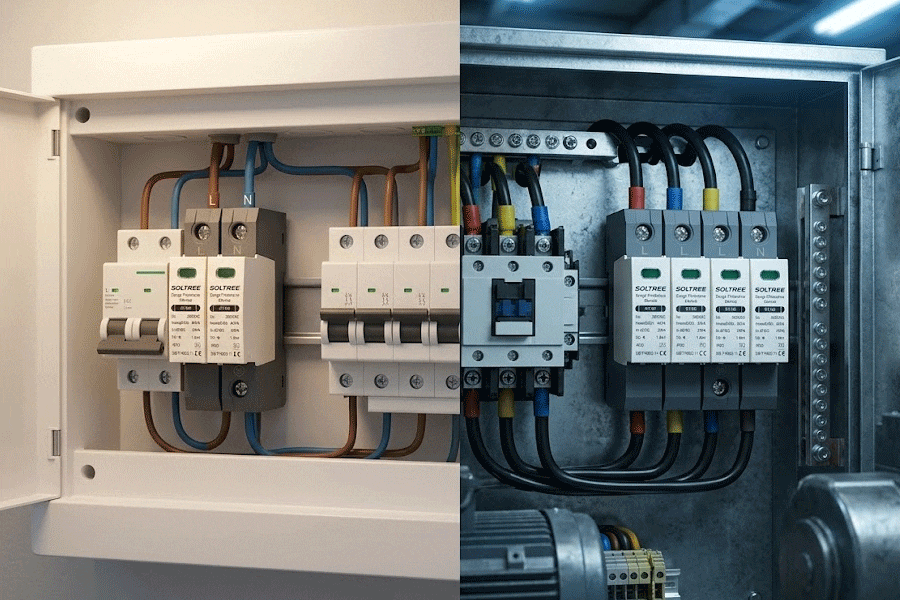
Whether you are wiring a single-phase home or a 3-phase factory, an SPD should never be installed in isolation. To build a truly safe and modern electrical panel, the SPD must be paired with specific backup protections and power monitoring components.
Here is the ultimate cross-selling blueprint for your DIN-rail enclosure:
1. The Single-Phase Distribution Board Setup
For residential and light commercial panels, arrange these components side-by-side on your DIN rail:
- Backup Protection: Always install a 2-Pole Miniature Circuit Breaker (MCB) upstream of your 1P+N SPD. If the SPD degrades and short-circuits over time, the MCB will trip, preventing a panel fire.
- The Surge Protector: Your Single-Phase 1P+N AC SPD to block microsecond lightning and switching spikes.
- Continuous Voltage Protection: Add a Single-Phase Over/Under Voltage Protector. The SPD stops split-second surges, but this smart relay protects your home appliances from sustained grid voltage drops or dangerous continuous high voltage.
- Smart Metering: A compact Single-Phase DIN Rail Energy Meter to track household or sub-tenant kWh consumption in real-time.
2. The Three-Phase Industrial Board Setup
For heavy-duty Motor Control Centers (MCC) and commercial main boards, you need industrial-grade counterparts:
- Backup Protection: A robust 4-Pole MCB or MCCBstrictly dedicated to the 3P+N SPD.
- The Surge Protector: Your heavy-duty Three-Phase 3P+N AC SPD (Uc 385V) to absorb massive industrial inductive surges.
- Phase Loss & Voltage Protection: 3-phase motors will burn out instantly if they lose a phase. Install a 3-Phase Over and Under Voltage Relay to monitor phase sequence, phase loss, and continuous voltage anomalies.
- Industrial Sub-Metering: A 3-Phase Smart Energy Meter to monitor industrial power quality and allocate energy costs per production line.
Sourcing SPDs from a Reliable OEM Manufacturer
Whether you are an EPC contractor outfitting a massive industrial park with 3-phase SPDs, or a distributor sourcing single-phase units for the residential market, partnering with a legitimate source factory is crucial.
When evaluating suppliers, look for a direct manufacturer that offers:
- Full Product Ecosystem: A reliable partner should supply the complete distribution board solution—from 1P+N and 3P+N SPDs to the complementary MCBs, Voltage Protectors, and DIN-rail Energy Meters.
- True IEC 61643-11 Compliance: Demand to see legitimate laboratory test reports verifying their T2 (8/20µs) and T1 (10/350µs) surge capacities.
- V0 Flame-Retardant Housings: Ensure all protective devices use the highest grade of fire-resistant plastics to guarantee panel safety during catastrophic grid events.
- OEM & Bulk Capabilities: Direct factories provide stable lead times, highly competitive wholesale pricing, and custom branding (silk-printing) to elevate your own distribution brand.
Ready to upgrade your electrical protection? Don’t let a sizing mistake leave your facility vulnerable. [Browse our full range of AC Surge Protective Devices] or [Contact Our Engineering Team] today to get a custom wiring schematic and a competitive B2B wholesale quote for your next project.