Picture this: It’s 11:00 PM on a stormy Tuesday night. The wind is howling, rain is battering your windows, and suddenly—everything goes pitch black.
In this moment, you have two choices.
Choice A: You scramble for a flashlight, put on your raincoat, brave the storm to drag your portable generator out of the garage, run extension cords through a cracked window, and manually flip switches in your breaker panel—all while soaking wet.
Choice B: You stay comfortably on your couch. You hear a faint hum outside, and 10 seconds later, the lights, the heater, and the WiFi turn back on automatically. You didn’t even have to put down your book.
The difference between these two scenarios isn’t just about the generator; it’s about the transfer switch.
Whether you are looking for a budget-friendly backup solution or total peace of mind, a transfer switch is not optional—it is a safety necessity. Plugging a generator directly into a wall outlet can cause backfeeding, sending lethal voltage back down utility lines, which poses a severe risk to utility workers trying to fix the outage.
But when it comes to choosing between a Manual Transfer Switch (MTS) and an Automatic Transfer Switch (ATS), the decision gets tricky. Is the convenience of automation worth the significantly higher price tag?
In this guide, we’ll break down the costs, installation requirements, and pros and cons of each system to help you decide which setup is right for your home and budget.
What is an Automatic Transfer Switch (ATS)?
To understand your backup power system, think of the generator as the muscle—it does the heavy lifting of producing electricity. The Automatic Transfer Switch (ATS), however, is the brain. Without it, your generator doesn’t know when to start or where to send the power.

An ATS acts as an intelligent bridge between your home’s breaker panel, the utility grid, and your generator. Its primary job is to monitor incoming voltage 24/7.
Here is the step-by-step process of how an ATS works during an outage:
- Utility Sensing (The Watchdog): The switch constantly monitors the voltage coming from the utility grid. When it detects a significant drop or a complete power loss, it prepares for action.
- Automatic Generator Start: After a brief delay (usually a few seconds) to ensure the power loss isn’t just a momentary blip, the ATS sends a signal to your standby generator to fire up.
- The Transfer: Once the generator reaches the correct speed and voltage, the ATS physically disconnects your home from the utility grid (isolating it to prevent backfeeding) and connects it to the generator. This happens automatically, usually within 10 to 20 seconds.
- Restoration & Cooldown: When utility power is restored, the ATS senses the stable voltage, switches your home back to the grid, and allows the generator to run for a “cool down” period before shutting it off.
⚠️ The “True Automation” Reality Check
While an ATS handles the switching automatically, true hands-free operation depends on your generator’s fuel source.
- Home Standby Generators (Best Match): These are typically connected to your home’s Natural Gas or Liquid Propane supply. Since the fuel is continuous, the system is 100% automated. You can leave for a two-week vacation, and the system will handle everything.
- Gasoline Generators: If you connect an ATS to a standard gasoline generator (provided it has an electric start), the switching is automatic, but the fueling is not. You still need to be home to refill the gas tank every few hours.
The Budget Alternatives: Manual Switches & Interlock Kits
If an automatic system feels like overkill for your needs—or your budget—there are two manual ways to safely connect a generator to your home. While these options save you money upfront, they require you to do the work when the lights go out.
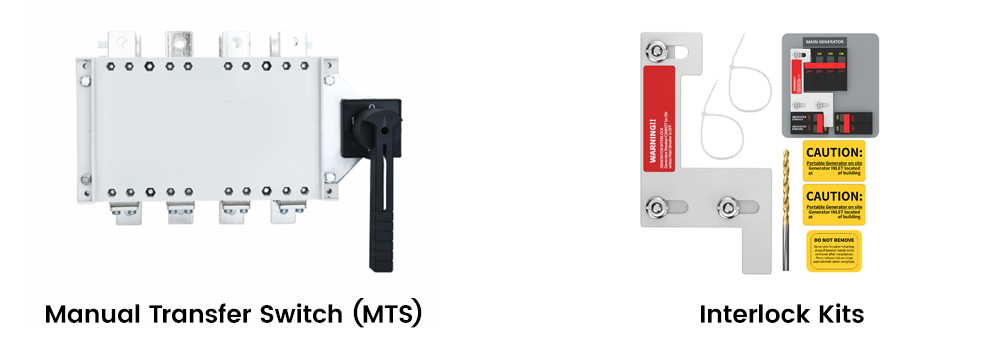
1. Manual Transfer Switch (MTS)
A dedicated Manual Transfer Switch is a small sub-panel installed next to your main breaker box.
- How it works: You select 6 to 10 specific circuits (like the refrigerator, furnace, and kitchen lights) to be wired into this sub-panel. When the power goes out, you plug your portable generator into an inlet box outside, flip the switch from “Line” to “Gen,” and manually toggle the breakers for the circuits you need.
- The Verdict: It offers a clean, foolproof way to power essential items, but you are limited strictly to the circuits you chose during installation.
2. Generator Interlock Kit (The DIY Favorite)
This is the most cost-effective legal way to connect a generator. An interlock kit is a simple metal plate that slides onto your existing electrical panel cover.
- How it works: It mechanically prevents the main breaker and the generator breaker from being turned on at the same time, ensuring safety. Unlike the dedicated sub-panel above, an interlock kit energizes your entire breaker panel.
- The Verdict: While it gives you the flexibility to power any circuit in the house (up to your generator’s limit), it requires disciplined load management. You have to manually turn off the AC before turning on the microwave to avoid overloading your generator.
🌧️ The “Manual” Reality: Are You Ready for the Rain?
Before choosing these budget options, visualize the process. When the power fails during a storm:
- You must be home (or your spouse/family member must know what to do).
- You have to go outside in the wind and rain to wheel out the generator and plug it in.
- You must manually flip the switches and balance the electrical load.
If you are comfortable with this hands-on approach, a manual setup can save you thousands of dollars. But if you want the power back on while you are on vacation—or simply don’t want to leave your warm bed—these options won’t help you.
The Premium Option: Automatic Transfer Switches (ATS)
If the Manual Transfer Switch is the “budget” choice, the Automatic Transfer Switch is the “lifestyle” choice. It is designed for homeowners who view electricity not just as a utility, but as a critical requirement for safety and comfort.
While the upfront cost is higher, modern ATS units come packed with features that justify the investment.
1. “Set It and Forget It” Peace of Mind
The defining feature of an ATS is 24/7 protection.
- Vacation Ready: If you are traveling in Florida and a blizzard hits your home in Chicago, an ATS ensures your sump pump keeps running (preventing a flooded basement) and your furnace stays on (preventing frozen pipes). A manual switch cannot do this.
- Medical Safety: For households with elderly family members or those relying on medical equipment (like CPAP machines or oxygen concentrators), an ATS isn’t a luxury; it’s a necessity.
2. Intelligent Load Management (The Money Saver)
This is the most overlooked feature of modern switches. In the past, if you wanted to power a central Air Conditioner, you needed a massive, expensive liquid-cooled generator. Not anymore.
Smart ATS units feature Load Shedding technology.
- How it works: If you turn on too many appliances at once (e.g., the oven, the dryer, and the AC), the ATS “sheds” (temporarily turns off) a low-priority load (like the AC) to prevent the generator from overloading. Once the oven is off, it brings the AC back online.
- The Benefit: You can buy a smaller, more affordable air-cooled generator to power your whole house, offsetting the cost of the switch itself.
3. Smart Home Integration & Mobile Monitoring
Welcome to the era of the “Smart Energy Ecosystem.” Leading brands like Generac and Kohler now offer Wi-Fi-enabled switches. Through a mobile app, you can:
- Receive alerts when the power goes out and the generator kicks in.
- Monitor your generator’s status and maintenance schedule from anywhere in the world.
- Check battery health to ensure the system is ready for the next storm.
4. The Weekly “Exercise” Cycle
Generators are like cars—if they sit unused for months, the battery dies and the engine seals dry out. An ATS includes a programmable Exercise Cycle. It automatically starts your generator once a week for 10-20 minutes to circulate oil and charge the battery. This ensures that when an emergency actually happens, the engine is ready to perform.
The Showdown: Manual vs. Automatic
Still undecided? Let’s break down the key differences side-by-side. This comparison assumes a standard setup for a medium-sized home.
Comparison Table: At a Glance
| Feature | Manual Transfer Switch (MTS) | Interlock Kit (DIY Option) | Automatic Transfer Switch (ATS) |
|---|---|---|---|
| Primary Benefit | Reliability & Low Cost | Extreme Affordability | Total Automation & Safety |
| Approx. Equipment Cost | $30 – $60 | $50 – $15 | $50 – $2,00+ |
| User Intervention | High: Must flip switches manually. | High: Must flip breakers manually. | Zero: Hands-free operation. |
| Outage Response Time | 5 – 15 minutes (depends on you). | 5 – 15 minutes. | 10 – 20 seconds. |
| Remote Protection | No. Requires someone on-site. | No. Requires someone on-site. | Yes. Protects home while away. |
| Installation Complexity | Moderate. Sub-panel wiring needed. | Low to Moderate. Panel cover mod. | High. Full service integration. |
| Maintenance | Minimal. | Minimal. | Moderate (Weekly auto-exercise). |
The Verdict Breakdown
- Choose the Interlock Kit IF: You are on a strict budget, comfortable identifying circuit breakers, and simply want to keep the fridge cold and a few lights on. It’s the “bare bones” legal solution.
- Choose the Manual Switch (MTS) IF: You want a foolproof system that anyone in the family can operate (with instruction) without risking an overload. It offers a cleaner separation of essential circuits.
- Choose the Automatic Switch (ATS) IF:
- You travel frequently.
- You rely on electricity for medical needs or sump pumps.
- You want the highest resale value for your home.
- You simply do not want to deal with gasoline, cords, and dark basements during a storm.
Critical Compatibility: Will It Work with My Generator?
Before you click “buy” on an ATS, you must navigate two critical technical hurdles: Generator Compatibility and Amperage Sizing. Getting this wrong means buying an expensive paperweight.
1. The Portable Generator Trap
A common question is: “Can I connect my portable generator to an Automatic Transfer Switch?”
The short answer: Usually, no. The long answer: An ATS requires a generator that speaks its language. Specifically, the generator must support “Two-Wire Start” capability.
- The Problem: Most portable generators require you to manually choke the engine, turn a key, or pull a cord. An ATS can send a “start” signal electronically, but if your generator doesn’t have an automatic choke and an electric starter, it physically cannot start itself.
- The Solution: If you are dead set on using an ATS, you must invest in a Standby Generator (designed for automation) or a high-end portable unit specifically equipped with a remote start/2-wire start interface. Do not assume your portable unit will work just because it has an electric start button.
2. Sizing Your Switch: 100 Amp vs. 200 Amp
The rule of thumb is simple: Match your transfer switch to your home’s main electrical panel.
- 200 Amp (The Standard): Most modern homes have a 200-amp service. Therefore, you need a 200 Amp ATS. This allows the switch to manage the entire load of the house.
- 100 Amp: Older homes or smaller cottages might only have 100-amp service.
- Pro Tip: You cannot install a 100 Amp switch on a home with a 200 Amp service—it will become a bottleneck and a fire hazard.
3. The “Service Entrance” Secret (Money Saver)
When shopping, you will see switches labeled “Service Entrance Rated” (SE Rated).
- Standard ATS: Requires a separate disconnect switch (fuse box) between the meter and the transfer switch. This means more equipment and more labor hours for the electrician.
- SE Rated ATS: Incorporates the main utility disconnect directly into the switch.
- Why it matters: It allows the electrician to install the ATS directly after your electric meter. While the unit itself might cost slightly more, it often lowers the total installation cost by simplifying the wiring and reducing the number of boxes on your wall.
4. Location, Location, Location (NEMA Ratings)
Finally, decide where the switch will live.
- NEMA 1 (Indoor Only): Cheaper, but must be installed inside the garage or basement.
- NEMA 3R (Outdoor Rated): Weatherproof. This is often the better choice as it can be installed right next to your outdoor electric meter, significantly shortening the wire runs (and the cost of copper wire).
The Real Cost: Installation, Permits & ROI
One of the biggest misconceptions about transfer switches is the price tag. You might see an ATS online for $500 and think, “That’s cheap!” But the sticker price is only half the story.
Here is the honest breakdown of what you are actually paying for.
1. Equipment vs. Installation Labor
The switch itself is often the cheapest part of the equation.
- Manual Switch / Interlock Kit: Hardware costs $50–$400. Installation typically takes 2–4 hours. Total estimated project cost: $500–$1,000.
- Automatic Transfer Switch: Hardware costs $500–$2,000+ (depending on amperage). However, installation is complex. It involves mounting the unit, rerouting heavy-gauge service entry cables, and potentially upgrading your gas meter (if using natural gas). Total estimated project cost: $2,000–$5,000+.
Note: Prices vary heavily by region and the distance between your gas meter, electric meter, and generator.
2. The “Paperwork” Cost: Permits & Inspections
This is not a DIY weekend project. Installing a transfer switch involves modifying your home’s main service entrance, which requires a building permit and a visit from a local electrical inspector.
- The Risk: Skipping the permit might save you $200 upfront, but it can cost you everything later. If an unpermitted installation causes a fire, your homeowner’s insurance policy may deny your claim.
- The Rule: Always hire a licensed electrician who pulls the necessary permits. It is your only proof that the work was done to code.
3. The Return on Investment (ROI)
While the upfront cost of an ATS is high, it is a recoverable investment.
- Resale Value: A home equipped with a hardwired standby generator and ATS is a major selling point. According to Consumer Reports, a standby generator system can increase your home’s value by up to 5%.
- Loss Prevention: Calculate the cost of replacing a fridge full of food, repairing frozen pipes, or staying in a hotel for three days. An ATS pays for itself by preventing these losses during a single prolonged outage.
Conclusion: Which Switch Should You Choose?
At the end of the day, both Manual and Automatic Transfer Switches share the same noble goal: keeping your lights on and your family safe during a blackout. The “best” choice isn’t about which technology is superior; it’s about which system fits your lifestyle and your bank account.
Here is our final verdict:
- Stick with a Manual Switch (or Interlock Kit) IF:
- You are on a tight budget and want the most cost-effective solution.
- You are physically capable and willing to set up the generator in bad weather.
- You are rarely away from home for long periods.
- The Bottom Line: It requires work, but it gets the job done for a fraction of the price.
- Upgrade to an Automatic Transfer Switch (ATS) IF:
- You want a “set it and forget it” solution that works even when you are on vacation.
- You have elderly family members, medical equipment, or a home business that cannot tolerate downtime.
- You want to maximize your home’s resale value.
- The Bottom Line: It is a significant investment, but the price buys you something money can’t usually buy: total peace of mind.
What Next? Electricity is dangerous. Regardless of which path you choose, do not attempt to install these devices yourself unless you are a qualified professional. Contact a licensed electrician today to assess your home’s load requirements and get a quote.
Don’t wait for the next storm to leave you in the dark—make your decision while the lights are still on.