
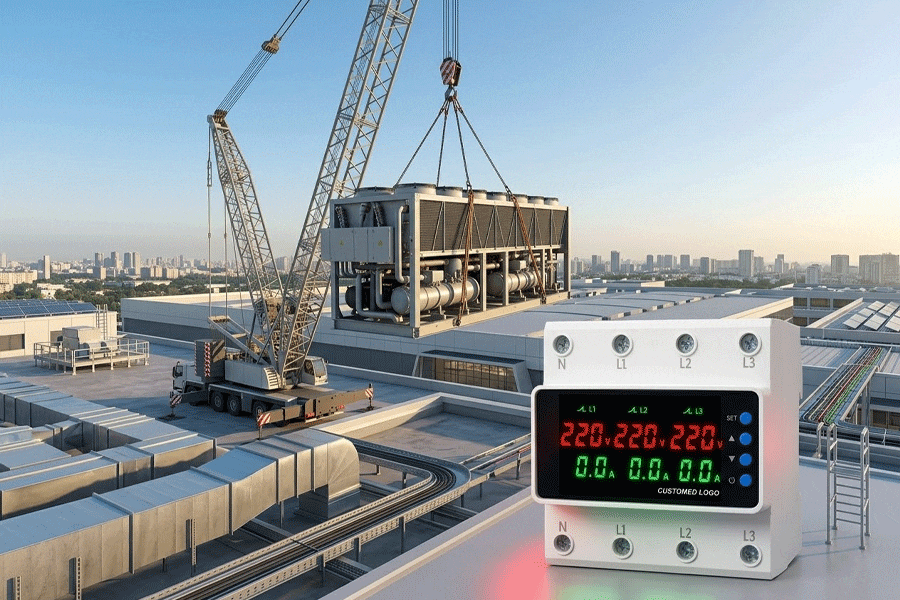
In commercial facility management and industrial fluid engineering, a 50-ton rooftop chiller or a heavy-duty submersible deep-well pump represents a massive capital investment. However, when these critical systems fail, the true financial nightmare is rarely the cost of the hardware itself. The real devastation lies in the catastrophic hidden expenses: emergency crane rentals to hoist a replacement compressor onto a 30-story roof, specialized labor for hazardous refrigerant recovery, or the exorbitant rig costs required to pull a dead pump from 500 feet underground.
These essential systems rely on robust three-phase motors to operate continuously. Yet, despite being housed in heavy-duty control panels, they remain completely at the mercy of unpredictable utility grid fluctuations. To safeguard these multi-thousand-dollar assets and prevent business-halting downtime, relying on basic circuit breakers is engineering negligence. Integrating a dedicated 3 phase voltage protector is the ultimate, non-negotiable first line of defense.
Why Traditional Breakers Fail Commercial Compressors and Pumps
When a commercial HVAC contractor is called to replace a completely burnt-out compressor, the inevitable question from a frustrated building owner is: “Didn’t the breaker trip?”
The harsh engineering reality is that standard Miniature Circuit Breakers (MCBs) and basic thermal overload relays are designed primarily to protect wiring from catastrophic short circuits and mechanical jams. They are fundamentally ill-equipped to defend sensitive motors against the complexities of dirty power. This blind spot leads to two distinct, highly expensive modes of failure.
1. The “Single-Phasing” Death Trap
The most lethal threat to any three-phase compressor or pump is phase loss, commonly known as “single-phasing.” This occurs when one of the three incoming power lines drops dead due to a blown utility fuse or a pitted contactor.
When a running motor loses a phase, it desperately attempts to maintain its mechanical load. This forces the remaining two live phases to draw up to 173% of their normal running current. Here is why the traditional breaker fails: this current surge often does not immediately exceed the extreme “instant trip” threshold of a standard thermal-magnetic breaker. Instead, the breaker’s internal bimetallic strip heats up agonizingly slowly. During these critical minutes, the extreme negative sequence currents act like a microwave inside the motor, rapidly baking the winding insulation until it triggers a catastrophic single phasing motor failure.
2. The Short-Cycle Threat and High Head Pressure
Power loss is dangerous, but for HVAC systems, power restoration can be even deadlier. If a grid experiences a momentary voltage dip or a one-second blackout, standard contactors will drop out and immediately pull back in when power returns.
For a commercial compressor, this is a death sentence. The system’s high-pressure refrigerant has not had time to equalize. Restarting against this massive internal pressure (High Head Pressure) causes the compressor to enter a “Locked Rotor” state, pulling massive locked-rotor amps (LRA) and instantly melting the coils. Standard breakers have no concept of time and cannot prevent this.
The Active, Intelligent Shield
To actively prevent HVAC compressor burnout, the control panel requires the dedicated intelligence of a microprocessor-driven phase relay.
Unlike a passive breaker, a modern 3 phase voltage protector monitors the true RMS voltage in milliseconds. More importantly, it features an Adjustable Auto-Recovery Delay. After a grid fault, it physically locks out the control circuit, enforcing a strict “3-minute rule.” It refuses to let the compressor restart until the refrigerant pressure has safely equalized, completely eliminating the risk of short-cycling and locked rotors.
HVAC Phase Monitors: Saving $10,000 Chillers from Dirty Power
For commercial HVAC contractors, a rooftop unit (RTU) or a large-scale chiller is the crown jewel of a building’s climate control system. At the heart of these massive systems are three-phase scroll or screw compressors. They are incredibly powerful, yet shockingly fragile when exposed to chronic voltage anomalies.
When a 50-ton commercial compressor fails, facility managers are not just faced with the hardware replacement cost. The true financial bleed comes from emergency crane rentals, hazardous refrigerant recovery, and the inevitable loss of business due to an un-airconditioned commercial space.
The most insidious enemy of these systems is Voltage Unbalance. A utility grid struggling under peak summer demand will often deliver unequal voltages across the three phases. According to rigorous NEMA engineering standards, a mere 2% voltage unbalance causes a massive 10% current unbalance. This disproportionate current drastically increases the operating temperature of the compressor motor, effectively cutting its expected lifespan in half.
To combat this, top-tier HVAC manufacturers mandate the installation of an adjustable voltage unbalance relay 380V. This intelligent device provides absolute commercial compressor phase protection by continuously monitoring the voltage symmetry.
Eliminating “Nuisance Tripping” in HVAC Systems
In a heavy industrial environment, the grid is noisy. The startup of a nearby elevator or heavy machinery can cause a harmless, momentary voltage dip (lasting less than a second). A cheap, overly sensitive relay will instantly shut down the entire chiller—a phenomenon known as “Nuisance Tripping.” This leads to erratic cooling and furious calls to the maintenance team.
A premium HVAC phase monitor relay solves this with an Adjustable Trip Delay (e.g., 2 to 5 seconds). It acts as a highly intelligent filter, ignoring harmless, split-second grid noise, and only executing a shutdown when a genuine, sustained voltage unbalance threatens to melt the compressor.
Protecting Submersible Pumps: The Nightmare of Phase Reversal
While HVAC systems battle chronic voltage unbalance and overheating, industrial fluid engineering and deep-well agriculture face a different, purely mechanical terror: Phase Reversal.
In municipal water treatment plants and commercial high-rise pressure boosters, three-phase submersible and centrifugal pumps are the lifeblood of the operation. Unlike a rooftop AC unit, a submersible pump is often buried hundreds of feet underground. If it fails, the cost to mobilize a drilling rig and pull the dead pump out of the well is astronomical.
A phase reversal occurs when the sequence of the incoming power lines (L1, L2, L3) is accidentally swapped. This happens far more frequently than expected—often occurring after municipal grid repairs, post-storm utility reconnections, or when a facility automatically switches to a backup diesel generator.
When the phase sequence is reversed, the magnetic field inside the stator rotates in the opposite direction, forcing the pump to spin backward at full speed. For a centrifugal or submersible pump, this is a multi-layered mechanical disaster:
- Dry Running and Overheating: A pump spinning backward produces little to no water flow. Because submersible motors rely strictly on the continuous flow of water to cool their internal windings, a reversed pump will rapidly overheat and burn out in minutes.
- The Mechanical Tear-Down (Impeller Unscrewing): The sudden reversal of torque is catastrophic for the pump’s mechanical assembly. Running in reverse can cause the pump’s internal impellers to loosen, unscrew entirely, and shatter, sending metal shrapnel through the fluid system and permanently destroying the hardware.
Installing a submersible pump phase protector inside the pump control box is the absolute only way to prevent pump phase reversal damage. This relay acts as an unforgiving gatekeeper. Before it ever allows the main pump contactor to close, it verifies the perfect L1-L2-L3 sequence. If the utility company crosses the wires, the protector simply refuses to start the pump, locking it out and triggering a red warning sequence. A $50 intelligent relay effectively neutralizes a $15,000 mechanical catastrophe.
Integrating the Protection Ecology into Your Control Panel
Understanding the devastating consequences of phase loss and reversal is only half the battle. For the panel builder, HVAC technician, or pump installer, the real value lies in flawless field execution and system integration.
A common, dangerous misconception among junior technicians is that a phase relay must be massive to handle the heavy load of a 50-ton compressor. In reality, the voltage protector acts purely as the highly intelligent “brain,” while a separate, robust 3 phase heavy-duty magnetic contactor acts as the “muscle.” The internal contacts of a phase monitor are typically rated for a delicate 5A to 10A—they do not carry the main 100A motor current.
Instead, the relay is wired into the secondary control circuit. Here is the standard integration protocol for high-end HVAC and water pump control boxes:
- Voltage Sampling: The relay’s sensing terminals (L1, L2, L3) are tapped directly from the main incoming power block, allowing the microprocessor to analyze the grid’s health before power reaches the motor.
- The Control Loop Integration: The engineer utilizes the relay’s Normally Closed (NC) contact (typically terminals 11 and 12). This NC contact is wired in series with the coil (A1/A2) of the main contactor.
- The Failsafe Execution: The exact millisecond the protector detects a phase loss or critical unbalance, it forces the NC contact open. The contactor coil instantly loses power, snapping open the main high-voltage lines and isolating the expensive motor from the dirty grid.
The Modern Panel: Digital Diagnostics and BMS Connectivity
Building a resilient control panel today requires more than basic protection; it demands an interconnected ecology.
When a fault occurs at a remote water boosting station 50 miles away, sending a technician just to diagnose the problem is a massive waste of resources. By upgrading to a premium digital phase monitoring relay with LCD, maintenance crews gain a true “Black Box” with Fault Memory, displaying exact error codes (e.g., Err: Phase Reversal) directly on the screen.
For large-scale commercial buildings, these high-end relays feature RS485 Modbus communication. This allows the protector to integrate seamlessly into the facility’s Building Management System (BMS) or SCADA network. If a chiller drops a phase on the roof, the chief engineer receives an instant alert on their computer screen in the basement control room.
Furthermore, to complete the modern panel ecology, top-tier builders routinely install a 3 phase DIN rail energy meter alongside the protector. This allows facility managers to actively track the massive power consumption of their HVAC units, turning a simple control box into a comprehensive energy and protection hub.
Source OEM Control Panel Components for Your Manufacturing
When you are manufacturing high-end commercial chillers, elevators, or engineering municipal water boosting stations, the reliability of your control panel is the ultimate signature of your brand’s quality. Sourcing generic, unverified protection relays from trading middlemen is a gamble that puts your engineering reputation—and your clients’ multi-thousand-dollar assets—at extreme risk.
To build motor control centers (MCC) that survive the harshest grid conditions, manufacturers must partner directly with a dedicated source factory for their OEM HVAC control panel components.
By working directly with a premier electrical manufacturer, you eliminate the middleman markup and gain access to a complete, industrial-grade engineering ecosystem:
- Custom OEM & Branding: We provide tailored solutions, including custom voltage parameter adjustments, tailored delay settings, and silk-screening your company’s logo onto the relay faceplates, elevating your brand’s professional presentation.
- Rigorous Quality Control: Every single unit undergoes 100% full-load burn-in testing, simulating extreme phase loss, voltage dips, and phase reversal strikes before it ever leaves the factory floor.
- Complete BOM Fulfillment: Streamline your supply chain. Whether you need a dozen units for a custom project or thousands of wholesale 3 phase pump protectors, magnetic contactors, and energy meters for your standardized production lines, a true source manufacturer guarantees stable lead times and perfectly compatible components.
Stop risking your most expensive equipment on cheap breakers and blind relays. Protect your commercial compressors, save your submersible pumps from mechanical destruction, and drastically reduce your warranty callbacks.
Contact our engineering team today to request comprehensive technical datasheets, discuss your custom OEM requirements, and secure highly competitive wholesale pricing for your next manufacturing run.