
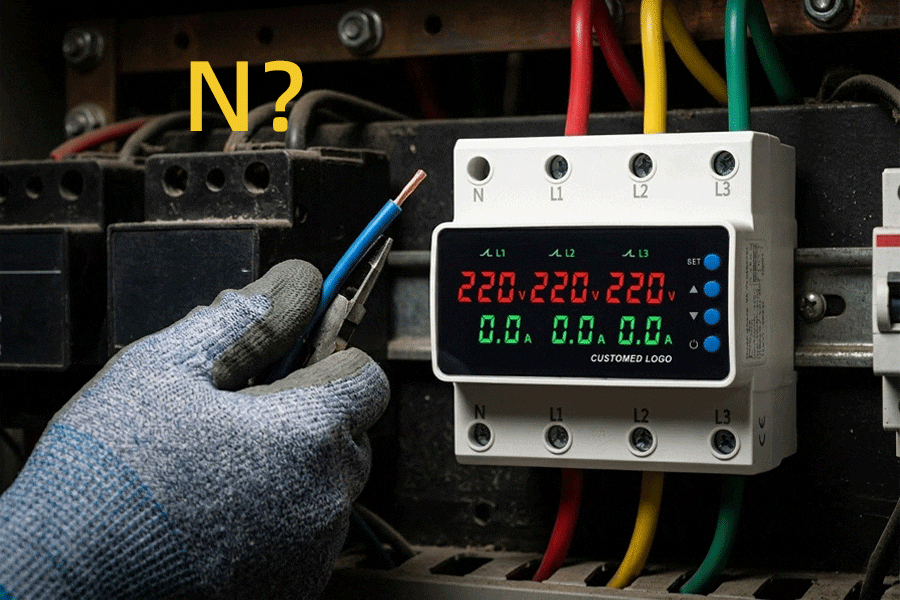
It is a scenario that plays out in industrial plants and pump stations every single day: A panel builder or field technician opens the control cabinet to install a brand new 3 phase voltage protector. They look at the incoming power block and see only three hot wires (L1, L2, L3) and a ground. Then, they look down at the protection relay in their hand and notice a terminal clearly labeled “N” (Neutral).
They pause, scratch their head, and ask the ultimate wiring question: “Does a 3 phase monitor need a neutral? What happens if I just leave it empty?”
If you connect the wrong phase monitor to your grid, the relay will either constantly fault out, or worse, fail to protect your equipment during a catastrophic power anomaly. The answer to this question isn’t a simple “yes” or “no.” It depends entirely on your grid architecture and your specific load. Let’s break down the technical differences between 3-phase 3-wire vs 3-phase 4-wire systems so you never buy or wire the wrong relay again.
3-Phase 3-Wire (3P3W) Systems: No Neutral Needed
If your control panel is designed strictly to run heavy-duty pure motor loads—such as a 50-ton commercial HVAC compressor, a deep-well submersible pump, or an industrial fan—you are likely dealing with a 3-Phase 3-Wire (3P3W) system.
These systems typically utilize a Delta wiring configuration from the utility transformer. In a pure 3P3W system, the motor operates perfectly using only the three hot phases (L1, L2, L3). There is physically no neutral wire pulled into the cabinet.
The Solution: For these applications, you must specify a 3P3W Delta phase protector. This specific relay monitors the Line-to-Line voltage (e.g., the 380V, 400V, or 480V jumping directly between L1-L2, L2-L3, and L1-L3). It does not look for, nor does it have a terminal for, a neutral wire.
3-Phase 4-Wire (3P4W) Systems: When “N” is Mandatory
Now, let’s look at a different scenario. What if your main 3 phase distribution board is not just powering a massive motor, but also supplying power to 220V/230V single-phase devices?
Many automated control panels have mixed loads. They run 380V to the main magnetic contactor for the motor, but they also need standard single-phase 220V to power the PLC (Programmable Logic Controller), the HMI touch screen, cooling fans, and cabinet lighting.
To achieve this, the utility provides a Wye (or Star) configuration, delivering three hot lines plus a dedicated Neutral wire, creating a 3-Phase 4-Wire (3P4W) system.
The Solution: You must use a 3P4W Wye phase protector. This relay requires you to connect the Neutral wire to the “N” terminal. Why? Because the microprocessor inside the relay is actively measuring the Line-to-Neutral voltage (e.g., checking that L1-N, L2-N, and L3-N all steadily measure 220V).
The Hidden Danger: Why You Need “Lost Neutral Protection”
If you are running a 3P4W system, there is a grid disaster that is actually far more terrifying than a standard phase loss: The Zero Line Break (or Lost Neutral).
If the main Neutral wire snaps, burns out, or becomes loosely disconnected at the utility pole, the neutral point inside your electrical system forcefully “shifts.” The incoming 380V power has nowhere to return, so it surges across your 220V circuits.
In a fraction of a second, the voltage on your standard 220V outlets and PLC power supplies will violently spike to 300V, 350V, or even the full 380V. This zero line break overvoltage will literally explode the capacitors inside your single-phase electronics, causing thousands of dollars in catastrophic damage and potential electrical fires.
This is why connecting the “N” wire to a premium 3P4W digital relay is so critical. High-end protectors feature dedicated lost neutral protection. The exact millisecond the relay detects that the neutral connection is severed, it triggers the main contactor to slam open, isolating and saving all your sensitive 220V electronics from the high-voltage surge.
Fool-Proof Wiring: Don’t Leave ‘N’ Floating!
A common rookie mistake in the field is buying a 3P4W protector (because it was in stock) and trying to use it in a 3P3W motor control box by simply leaving the “N” terminal empty (floating).
Never do this. A 3P4W relay relies on the neutral reference to calculate voltage. If you leave the ‘N’ terminal disconnected, the relay’s microprocessor will assume there is a massive “Lost Neutral” fault and will permanently lock out your control circuit. The motor will simply refuse to start. Always match the relay to the grid architecture.
How to Choose the Right Protector for Your Panel?
Selecting the correct 3 phase voltage protector is the first step in building a resilient, professional-grade control panel.
Whether you are engineering a pure 3P3W motor control center for a commercial chiller, or assembling a complex 3P4W distribution board that requires elite lost neutral protection, you need industrial-grade components you can trust.
Stop guessing with generic relays. Upgrade your BOM (Bill of Materials) with our comprehensive line of adjustable digital phase relays. We manufacture exact, highly accurate models for both 3-Wire (Delta) and 4-Wire (Wye) applications, featuring precise LCD parameter adjustments to secure your expensive equipment against the unpredictable utility grid.
Contact our engineering team today to source the exact protection relay your next project demands.