Installing a Surge Protective Device (SPD) is the first step in defending your industrial equipment and Smart Home systems from catastrophic lightning strikes and transient overvoltages. However, merely snapping an SPD onto a DIN rail is not enough.
One of the most dangerous—and common—mistakes made by electricians and panel builders is failing to provide proper backup protection for the surge protector. Without correctly coordinating your SPD with an upstream Miniature Circuit Breaker (MCB) or Molded Case Circuit Breaker (MCCB), your protective device can quickly turn into a severe fire hazard.
In this definitive engineering guide, we will explore why SPDs need backup circuit breakers, how to wire them correctly (before or after the main breaker?), and provide the ultimate SPD-to-MCB sizing chart to ensure your distribution board is safe, compliant, and free from nuisance tripping.
The Hidden Danger: Why Do SPDs Need Backup Protection?
To understand why an MCB is mandatory, you must understand how an SPD dies.
Most modern AC Surge Protective Devices rely on Metal Oxide Varistors (MOVs). MOVs act like electrical sponges, absorbing microsecond voltage spikes and safely diverting them to the ground. However, MOVs are not immortal. Every time they absorb a surge, they degrade slightly.
The “End of Life” Risk: When an SPD reaches the end of its lifespan, or if it absorbs a catastrophic surge far beyond its maximum discharge capacity (Imax), the MOV fails. When it fails, it typically drops into a permanent short-circuit state.
If there is no dedicated circuit breaker installed upstream of the SPD to disconnect it from the grid, this short circuit will draw a massive 50/60Hz follow-current from the main power supply. Within seconds, the SPD will overheat, melt its plastic housing, and potentially ignite a fire inside your distribution board.
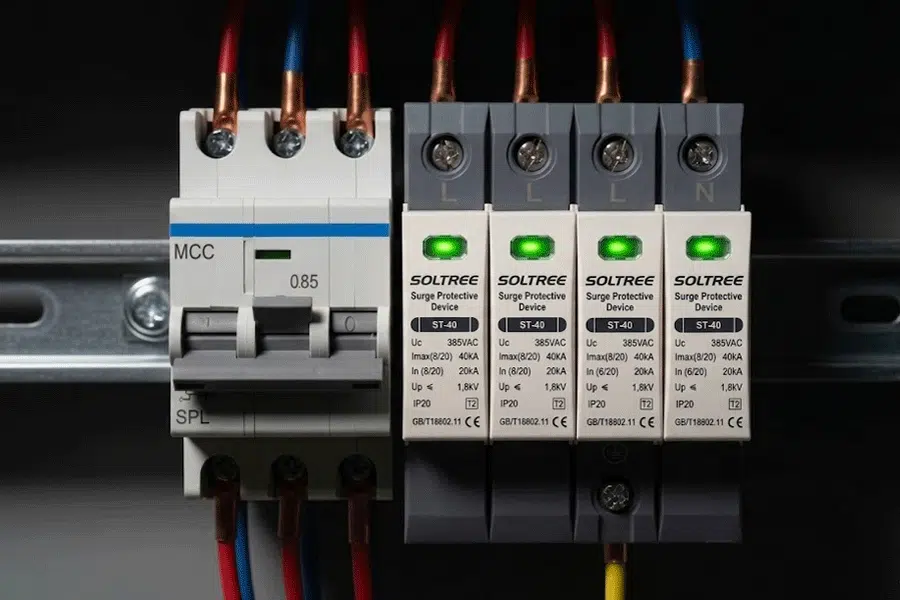
A properly coordinated Miniature Circuit Breaker (MCB)acts as the ultimate fail-safe. If the SPD short-circuits, the MCB instantly trips, safely isolating the dead surge protector while allowing the rest of your facility to stay powered on.
Where to Install: Before or After the Main Breaker?
This is the most hotly debated topic in electrical forums: Where exactly does the SPD and its backup breaker go?
The Standard Best Practice: In a standard TN-S or TT distribution board, the SPD and its dedicated backup MCB should be installed in parallel to the loads, directly AFTER the main incoming isolator/breaker, but BEFORE the individual branch circuit breakers (like RCDs/RCBOs).
The “0.5 Meter” Wiring Rule
When wiring your SPD and MCB, physical distance is just as critical as component sizing. According to IEC 61643-11 wiring guidelines, the total length of the connecting cables (from the live busbar → through the MCB → through the SPD → to the earth terminal) must not exceed 0.5 meters (50 cm).
If the wires are too long, the inductance of the cable will create its own voltage spike during a surge, rendering the SPD entirely useless. Keeping the SPD and its backup MCB side-by-side on the DIN rail ensures the shortest possible lead length.
The Ultimate Sizing Guide: Matching SPD Capacity with MCBs
You cannot use just any breaker for your SPD.
- If the MCB is too small: It will trip prematurely during a normal, harmless surge, disconnecting your SPD and leaving your equipment totally unprotected (Nuisance Tripping).
- If the MCB is too large: It will not trip fast enough when the SPD actually short-circuits, leading to melted wires and panel damage.
To achieve perfect Cascading Coordination, you must match the discharge capacity (Imax) of the SPD with the correct Ampere (A) rating of the MCB.
Here is the standard engineering sizing chart for AC distribution panels:
| SPD Class & Capacity | Typical Application | Recommended Backup Circuit Breaker |
|---|---|---|
| Type 3 (Imax < 10kA) | Final circuits, Smart Home panels | 16A or 20A MCB (link to 16A MCB) |
| Type 2 (In 20kA / Imax 40kA) | Standard residential & light commercial | 32A or 40A MCB (link to 32A MCB) |
| Type 2 (Imax 60kA – 80kA) | Industrial sub-boards (SMDB), MCCs | 63A MCB (link to 63A MCB) |
| Type 1+2 (Imax 100kA+) | Main facility entrance (MDB), heavy industry | 100A / 125A MCCB (link to MCCB) or specified NH Fuses |
(Note: Always verify the exact Icc (Short-Circuit Current Rating) and manufacturer specifications printed on the side of the SPD before installation).
Avoiding Nuisance Tripping: Why the Breaker Curve (C or D) Matters
When selecting your backup [MCB for the Surge Protector] (link to your MCB product page), the Ampere rating is only half the battle. You must also select the correct tripping characteristic curve.
Lightning strikes and switching surges are high-frequency, extreme-energy pulses lasting only microseconds.
- Never use a “B Curve” MCB: B-curve breakers are highly sensitive to sudden inrush currents. If a lightning surge passes through a B-curve breaker on its way to the SPD, the breaker will falsely identify it as a short circuit and trip immediately. Your SPD is now offline, and the next surge will destroy your PLCs and TVs.
- Always use “C Curve” or “D Curve”: These breakers are designed to tolerate high momentary inrush currents without tripping. A C or D curve MCB will allow the microsecond lightning surge to pass harmlessly into the SPD to be grounded, but it will instantly trip if a sustained 50/60Hz short-circuit fault occurs (such as when the SPD reaches its end of life).
🔧 Pro Maintenance Tip: The Safe Way to Hot-Swap
Modern SPDs feature a visual status window that turns from Green to Red when the internal MOV is depleted. Never attempt to pull out a red cartridge while the panel is live! Always switch off the upstream backup MCB first to isolate the power, then safely pull out and replace the pluggable SPD module.
Sourcing Tested SPD & MCB Combos from a Single Manufacturer
In the world of low-voltage electrical protection, compatibility is everything. Purchasing your surge protectors from one generic supplier and your circuit breakers from another introduces a massive variable in cascading coordination. If a catastrophic failure occurs, identifying the weak link becomes impossible.
For panel builders, EPC contractors, and electrical distributors, sourcing both components from a single, verified OEM manufacturer is the ultimate guarantee of safety.
When you source your [AC Surge Protective Devices] and [Miniature Circuit Breakers] from our factory, you are investing in an ecosystem. Our SPDs and MCBs undergo rigorous, combined short-circuit and coordination testing in our laboratories to ensure they comply with strict IEC 61643-11 and IEC 60898-1 standards. They are engineered to work together flawlessly—preventing nuisance tripping while eliminating fire risks.
Ready to build a safer, bulletproof distribution panel? Stop guessing with mismatched components. [Contact our engineering team today] to get expert sizing advice, request coordinated wiring diagrams, and receive a competitive B2B wholesale quote for our fully tested SPD and MCB packages.