
The global solar market is booming, particularly in sun-drenched regions across the Middle East and Southeast Asia. However, for EPC contractors and solar installers, successfully mounting panels and connecting an inverter is no longer the finish line. Today, the biggest roadblock to a successful solar project is grid compliance.
What happens when your solar PV system generates more electricity than the facility consumes? If that excess power blindly rushes back into a fragile or restricted public grid, the consequences can be disastrous. It can lead to severe utility penalties, blown grid transformers, or outright rejection of your grid connection application. The cost of inaction here isn’t just a minor inconvenience—it can wipe out a project’s entire profit margin.
To solve this, the standard electrical setup falls short. This is exactly why your solar PV system needs a bi-directional DIN rail meter.
Far more than just a basic tracking tool, this compact device acts as the “smart brain” of your system’s AC side. Whether you are looking to monetize excess energy through net metering or secure grid approval via strict zero export control, the bi-directional meter is the ultimate gatekeeper. In this guide, we will break down exactly how this essential component works, why it outperforms standard meters, and how it fits into a completely protected solar setup.
1. The “One-Way Street” vs. The “Two-Way Street”: Understanding the Difference
To fully grasp why a specialized meter is necessary, we must first look at the difference between uni-directional and bi-directional energy meters.
Traditionally, buildings only consume power. A standard DIN rail energy meter acts like a “one-way street.” It is designed to measure electrical current flowing in a single direction: from the public utility grid into your facility to power your loads. It does this job perfectly for conventional setups.
However, the moment you install a solar PV system, everything changes. Your facility is no longer just a consumer; it becomes a “prosumer” (a producer and consumer of electricity). During peak sunlight hours, your solar panels might generate more power than your facility needs. This excess electricity then changes direction, flowing backward toward the grid.
A traditional uni-directional meter cannot differentiate between power coming in and power going out—it might even add the exported solar power to your electricity bill as if you consumed it!
This is where the bi-directional DIN rail energy meter steps in. Acting as a “two-way street,” its core DNA is the ability to sense the exact direction of the energy flow. It accurately tracks two separate data sets:
- Imported Energy: The electricity you buy from the grid when the sun goes down.
- Exported Energy: The excess solar electricity you send back to the grid.
Without this dual-measurement capability, modern solar grid integration is mathematically and functionally impossible.
2. Scenario A: Monetizing Your Solar Power with Net Metering
In regions with advanced infrastructure and supportive renewable energy policies, local utility companies actually encourage you to send your excess solar power back to the public grid. This arrangement is known as net metering.
Under a net metering agreement, the electricity you export earns you credits, which are then used to offset the cost of the electricity you import from the grid at night or on cloudy days. In this scenario, your bi-directional meter functions as a highly precise “cashier.”
Because every kilowatt-hour (kWh) equals real money, the accuracy of this meter is non-negotiable. If the meter is slightly off, the facility owner loses money on their utility bill every single month. Partnering with a professional solar energy meter supplier ensures you are installing Class 1.0 (or even 0.5s) precision devices that guarantee fair and accurate billing for your end-users.
3. Scenario B: The Critical Need for “Zero Export Control” (Anti-Reflux)
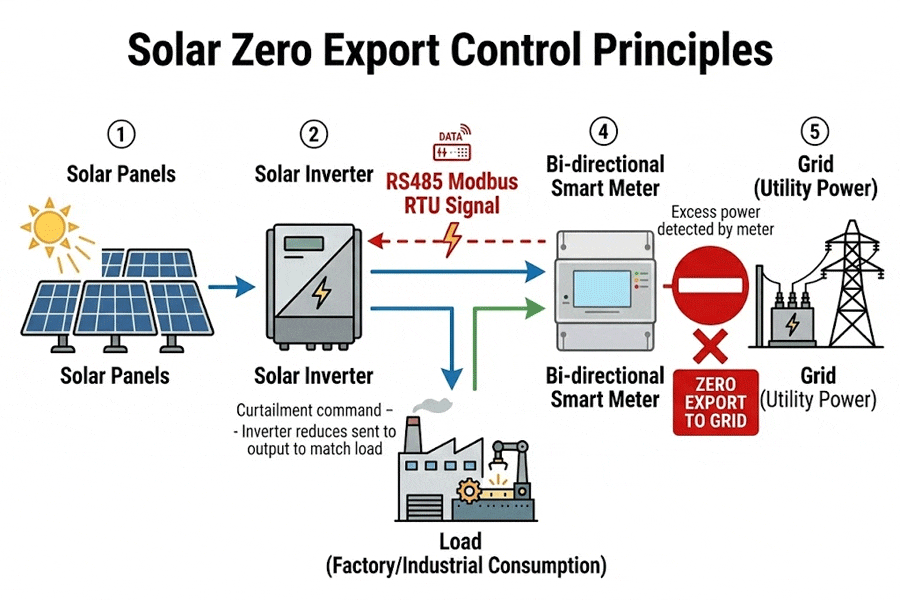
While net metering sounds ideal, it is not the reality for most commercial and industrial solar installations, especially in emerging markets. Many local utility grids simply cannot handle sudden surges of reverse power. Consequently, strict regulations are enforced: You are absolutely forbidden from feeding excess solar energy back into the public grid.
If your system violates this rule, you face severe financial penalties, or the utility company will permanently disconnect your facility. So, how to prevent solar power feed-in to grid while still maximizing your solar investment?
The answer lies in zero export control (also known as anti-reflux control), and your bi-directional meter is the key to making it work.
In this scenario, the meter stops being just a “cashier” and becomes an active “security guard.” Installed at the main incoming supply point, the meter constantly measures the facility’s load consumption and compares it against the solar energy being generated.
When the meter detects that solar generation is about to exceed consumption (meaning power is about to be exported), it instantly communicates with the solar inverter. A high-quality Modbus RTU energy meter for solar inverter uses an RS485 communication line to send a real-time signal: “Throttle down the power!” The inverter immediately reduces the solar output to perfectly match the facility’s load, ensuring zero electricity escapes into the grid.
Without a reliable, fast-communicating bi-directional DIN rail meter, zero export control is impossible, meaning your EPC project will never pass grid inspection.
4. The Journey of Solar Current: Complete Protection & Monitoring
While the bi-directional meter acts as the highly intelligent “brain” on the AC (Alternating Current) side of your system, monitoring energy flow and ensuring grid compliance, it cannot work alone.
If a sudden lightning strike or a severe short circuit destroys your expensive inverter, your smart AC meter becomes completely useless. A truly reliable solar installation requires both intelligent AC monitoring and robust DC (Direct Current) protection. To understand this, let’s trace the journey of the solar current:
**
The First Line of Defense: The DC Side When sunlight hits your solar panels, it generates high-voltage raw DC power. Before this power is allowed anywhere near your sensitive inverter, it must first be consolidated and protected. This is where the power enters the [Solar PV Combiner Box].
Inside this critical enclosure, several vital safety components stand guard:
- [DC Surge Protective Device (SPD)]: This acts as your lightning shield, absorbing massive voltage spikes caused by lightning or grid anomalies before they can fry your inverter.
- [DC Miniature Circuit Breaker (DC MCB)] & [1000V DC Fuses]: These act as the system’s strict firewalls. If an overload or short circuit occurs, the DC MCB and fuses instantly cut the circuit, preventing catastrophic electrical fires and equipment damage.
The Smart Brain: The AC Side Once the raw DC power is safely filtered and protected by the combiner box, it enters the inverter and is converted into usable AC power. It is only at this final stage, right at the grid connection point, that the AC current meets our main protagonist: the bi-directional DIN rail energy meter.
Protected from upstream electrical faults, the meter can now safely and consistently execute its precise net metering calculations or communicate via Modbus to enforce strict zero export control.
By sourcing a complete low voltage solar protection solution—from the upstream DC combiner box to the downstream AC bi-directional meter—EPC contractors can guarantee both the physical safety and the legal grid compliance of their solar projects.
5. How to Choose the Right Bi-Directional Meter for Your Projects
Not all energy meters are created equal. When sourcing components for your EPC solar projects or distribution network, selecting the wrong meter can lead to inaccurate billing, communication failures with the inverter, or outright rejection by local grid authorities.
Here are the top three factors a professional buyer must evaluate:
- Accuracy Class (The Precision Standard): A solar DIN rail meter accuracy class is paramount. For general solar monitoring and zero export control, a Class 1.0 meter is the industry standard, ensuring highly reliable data. However, if your project involves strict commercial tenant billing or utility-grade net metering, you should upgrade to a Class 0.5s meter for pinpoint financial accuracy.
- Connection Type: Direct vs. CT Operated: * Direct Connection: Ideal for smaller residential or light-commercial solar setups (typically up to 80A or 100A). The main power cables connect directly into the meter.
- CT (Current Transformer) Operated: Mandatory for large-scale industrial and commercial solar plants. Because the current is too massive to pass through a small DIN rail meter, external CTs clamp onto the thick main cables and step down the current for the meter to read safely. Always ensure your supplier provides a clear bi-directional energy meter wiring diagram for both types to avoid costly installation errors on-site.
- Certifications and Compliance: Never compromise on safety and legality. Ensure the meters carry standard CE and RoHS marks. Furthermore, if your market (especially in Europe or for official billing applications) requires strict legal metrology, always ask your supplier if their meters are MID Certified.
Conclusion: Partner with a Reliable Low-Voltage Solutions Expert
Building a safe, smart, and grid-compliant solar PV system shouldn’t require you to juggle half a dozen different suppliers. Your bi-directional meter needs to seamlessly protect your grid connection, just as your DC combiner box must flawlessly protect your inverter.
Why risk system mismatch or delayed shipments when you can source everything from one trusted manufacturer?
As a leading B2B solar electrical components supplier, we specialize in providing complete, high-quality low-voltage solutions. From premium PV combiner boxes equipped with robust DC SPDs and MCBs, to advanced wholesale bi-directional DIN rail meters (Modbus RTU ready), we manufacture the reliable components your solar projects demand.
Stop letting grid compliance and system safety be the bottlenecks of your solar business.
Ready to upgrade your solar installations with professional-grade protection and monitoring? Contact our engineering and sales team today for a custom wholesale quote, technical wiring diagrams, and fast global shipping. Let’s power a smarter, safer future together!