A heat-activated aerosol device may be considered for a specific enclosed hazard only after its exact model, test evidence and installation conditions have been reviewed. First identify whether the proposed product is a fire-extinguishing patch, a canister generator or another design. Do not transfer assumptions about agent, activation, testing or installation between designs. A patch or compact generator is not automatically suitable for every electrical cabinet. The Soltree device discussed in the previous version of this article has not been matched to a verified model-specific test report in the material available for this revision. Its activation temperature, protection volume, approvals and other performance claims remain unconfirmed.
For panel builders, distributors and facility buyers, the useful question is not simply whether a device fits inside a cabinet. It is whether the proposed product has evidence for the actual fire hazard, enclosure and operating environment, and whether a competent fire protection designer and the authority having jurisdiction accept the complete arrangement.
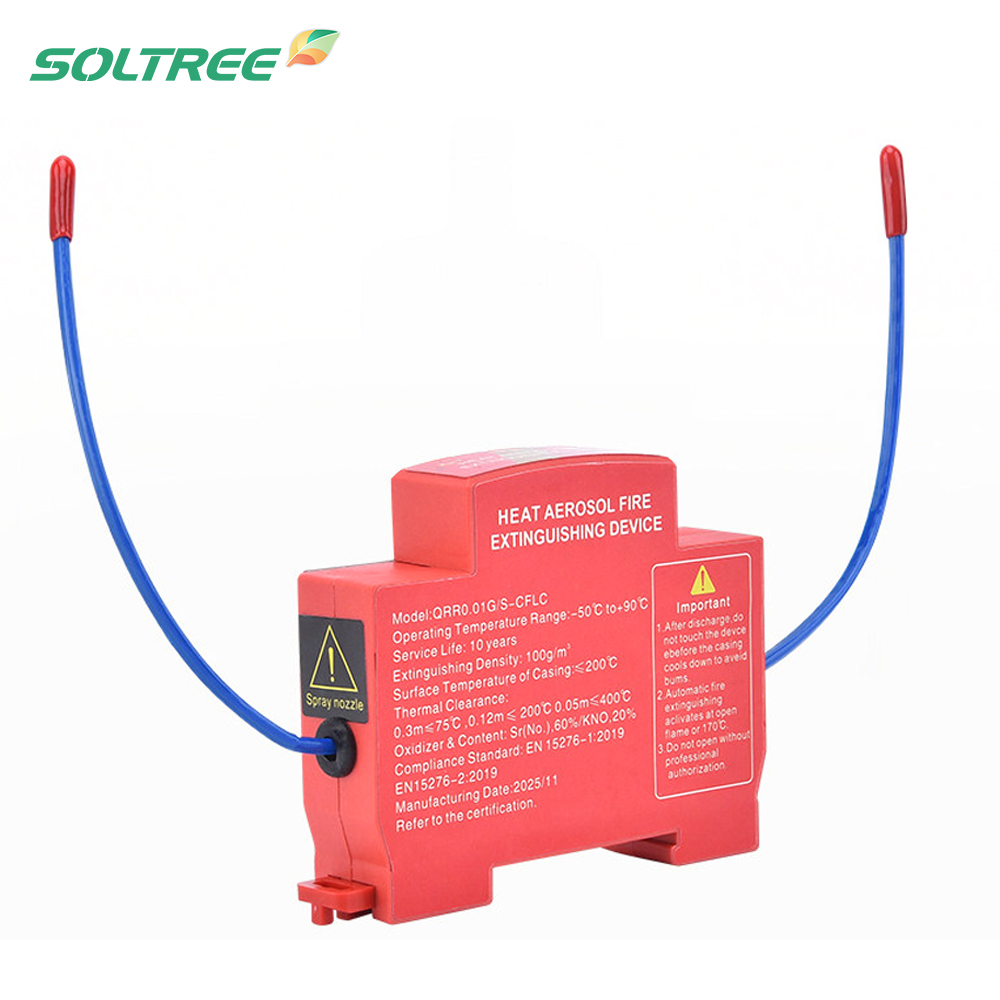
What is a heat aerosol fire extinguishing device?
Some compact devices use a heat-responsive element to initiate an aerosol-forming compound. Activation method and temperature depend on the design; neither can be inferred from appearance. Condensed aerosol generally contains fine solid particles and gases. A Fire Protection Research Foundation report hosted by NFPA describes interruption of the flame’s combustion chain reaction as a principal extinguishing mechanism. This is a general description, not proof that a particular Soltree device uses the same formulation or achieves a specific result.
A heat-responsive device is not necessarily an early-warning detector, an alarm or a means of electrical isolation. Activation depends on heat reaching its trigger under the conditions for which it was tested. A local hot spot, an obstruction or a different fire location may affect the response. Ask for the exact device’s activation conditions and representative fire tests; do not rely on an unverified temperature printed in an old advertisement.
Why does the enclosure matter?
For a total-flooding design, agent must reach and remain in the protected enclosure under the applicable design conditions. Cabinet volume is only one input. Openings, leakage, internal barriers, ventilation, expected temperatures and equipment arrangement can change distribution and retention. The Foundation report discusses the need for a closed enclosure and the potential conflict with ventilation in battery-energy-storage systems. A nominal volume in a catalogue cannot by itself establish protection for a particular cabinet.
Provide drawings and operating details to a qualified designer. Ask the supplier for the tested configuration, design limits and instructions for the exact model; the designer must assess the actual application, local requirements and any required approvals. Check which standard, edition and scope apply to the product and jurisdiction; the NFPA 2010 information page identifies a 2006 edition for reference, not proof of current applicability. This article is not a design or installation instruction.
Electrical equipment, people and residue
Do not assume that discharge makes energized equipment safe to touch or permits continued operation without isolation. Electrical isolation, alarms, emergency response and return to service must be addressed in the site’s plan by qualified personnel. A suppression device does not replace electrical protection, inspection, emergency procedures or the wider fire protection strategy.
Personnel exposure also requires a product-specific assessment. The US EPA list of total-flooding substitutes shows that different aerosol agents have different use conditions, including restrictions for some to normally unoccupied areas. Those entries are not approval of the Soltree device and do not establish its safety for occupied spaces. Obtain the exact agent safety data sheet, exposure information, discharge hazards, evacuation and re-entry instructions, and relevant local acceptance before selection.
Aerosol discharge may leave particles. The Foundation report notes residue and potential effects on electronics and corrosion in the battery-storage context. Avoid promises of zero residue or no corrosion without matching evidence. Request compatibility, cleaning, inspection and post-discharge recovery instructions for the actual equipment and agent. A fire or discharge may require equipment assessment and replacement; do not assume that a cabinet can immediately return to service.
What about batteries and other hazards?
Fire classes and suitability must be supported by tests for the specific device and hazard. A successful test on one cabinet or fuel does not establish performance for all electrical enclosures, open spaces, reactive materials or battery systems. For lithium-ion battery energy storage, the Foundation report says aerosol suppression is not expected to stop thermal runaway and does not provide thermal management. Battery off-gas and ventilation need a separate engineered assessment. Do not represent a small aerosol device as a solution to thermal runaway or explosion risk.
Buyer checklist: what to request
- Identification: manufacturer, exact model and version, product label, agent composition, current manual and safety data sheet.
- Evidence: complete independent test reports, fire scenarios, enclosure sizes and leakage conditions, activation temperature and tolerance, operating environment and tested limitations. Ask which evidence matches the supplied version.
- Application: enclosure drawings and dimensions, openings, ventilation, internal barriers, electrical equipment and fire load, occupancy, ambient conditions and destination country. Have a competent designer review the entire arrangement.
- Compliance: certificates or listings with issuing body, scope, validity and exact model; check local authority requirements. A standard’s name or another manufacturer’s listing is not a certificate for this product.
- Lifecycle: documented storage, inspection, maintenance and replacement intervals; service life, handling, transport, post-discharge cleanup and disposal. Do not assume maintenance-free or a stated lifetime without matching documentation.
Discuss the application with Soltree
Browse the Soltree product directory and contact Soltree with the information above to request available documentation and a review. A matching dedicated aerosol product page has not been verified for this revision. Do not treat this article as a product listing or a guarantee of protection. Selection and installation should follow the verified model documentation and the approved site-specific design.