
We have all been there: A severe storm hits, the grid power drops, and your backup generator kicks in. The lights flicker for just a second.
To a lightbulb, that one-second delay is nothing. But to your desktop computer, your Wi-Fi router, or your expensive server rack, that one second is a lifetime. Your computer screen goes black, your Zoom meeting drops, and you are left waiting three agonizing minutes for your internet modem to reboot and reconnect.
If you are upgrading your home backup or solar system, you will quickly notice a massive debate in the Automatic Transfer Switch (ATS) market: The slow 3-second ATS versus the lightning-fast 0.02-second (20ms) ATS.
Do you really need millisecond transfer speeds? Or is a cheaper, slower switch good enough? Let’s break down the hidden “reboot rules” of your electronics and find out which ATS you actually need.
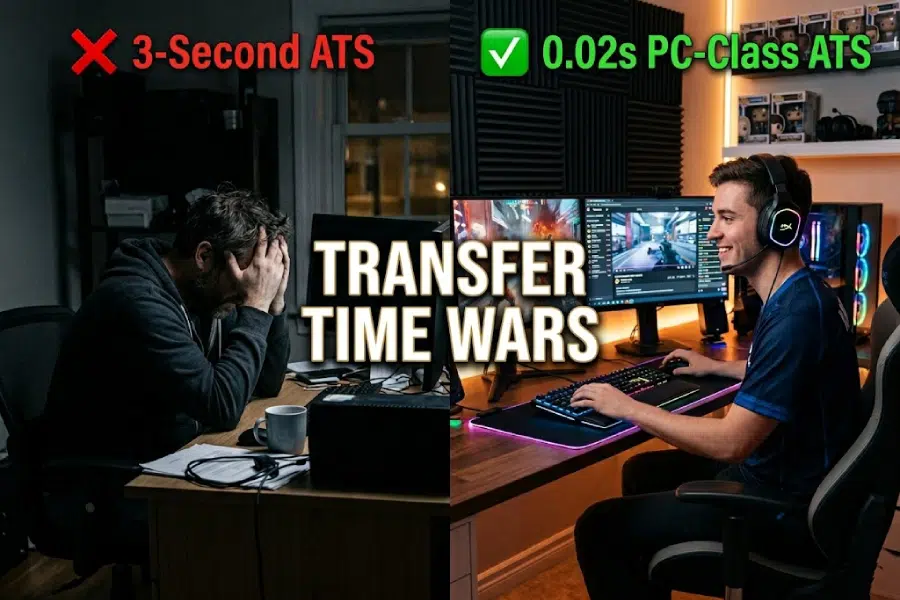
The 3-Second ATS (CB-Class): Good Enough for the Basics
When you buy a standard, budget-friendly transfer switch online, you are almost always getting a CB-Class (Circuit Breaker) ATS.
These switches use internal motors to physically flip standard circuit breakers on and off. Because they rely on slow mechanical gearing, the transfer process is deliberate and slow:
- Detect grid failure.
- Mechanically open the grid breaker.
- Pause (to ensure any electrical arcs are extinguished).
- Mechanically close the generator/solar breaker.
The result? A 1.5 to 3-second total blackout. If you are only backing up your refrigerator, your HVAC compressor, and your hallway lighting, a 3-second CB-Class ATS is perfectly fine. Heavy appliances do not care about a brief pause. But if you have smart home devices or computers, get ready for everything to shut down and reboot.
The 0.02s ATS (PC-Class): The “Seamless” Ninja
If you want to keep your internet running and your PC screens on during a power outage, you need a PC-Class Automatic Transfer Switch.
Instead of flipping heavy breakers, a PC-Class ATS utilizes an advanced electromagnetic coil and a mechanical latching mechanism. It operates like a high-performance dual-clutch transmission in a sports car. The switch from Grid to Reserve happens in a blink of an eye—typically under 20 milliseconds (0.02 seconds).
The “20ms Rule”: Why 0.02 Seconds is the Magic Number
Why is 20 milliseconds the industry standard for fast transfer switches? It all comes down to how your electronics are built.
Every desktop computer power supply (ATX standard) and router adapter has internal capacitors. These capacitors store a tiny amount of emergency energy, known as “Hold-Up Time.” For most high-quality PC power supplies and modems, the hold-up time is exactly 16 to 20 milliseconds.
If your ATS can complete the power transfer before those 20 milliseconds run out, your computer’s capacitors will bridge the gap. Your PC will never know the power grid failed, and your router will stay perfectly connected. It is virtually seamless.
Device Tolerance Cheat Sheet: Can It Survive the Switch?
Before you buy an ATS, look at what you are trying to power. Here is the ultimate cheat sheet for what different devices can tolerate before they shut down and reboot:
| Device Type | Tolerance (Hold-Up Time) | Will it survive a 3s ATS? | Will it survive a 0.02s SATS? |
|---|---|---|---|
| Desktop PCs & Servers | < 20ms | ❌ No (Reboots) | ✅ Yes (Seamless) |
| Routers, Modems & Switches | < 40ms | ❌ No (Drops Internet) | ✅ Yes (Stays Online) |
| Smart TVs & Gaming Consoles | < 50ms | ❌ No (Shuts Off) | ✅ Yes (Seamless) |
| Smart Home Hubs (Raspberry Pi) | < 100ms | ❌ No (Reboots) | ✅ Yes (Seamless) |
| LED Lighting | < 200ms | ⚠️ Flickers visibly | ✅ Unnoticeable blink |
| HVAC, Fridges, Pumps | > 2000ms | ✅ Yes | ✅ Yes (Best for motor health) |
Conclusion: If you have a modern home office, a gaming setup, or a smart home ecosystem, a 3-second ATS will drive you crazy. You absolutely need a 0.02s transfer switch.
Stop Restarting Your Routers: Upgrade to SATS DIN-Rail Switches
In the past, if you wanted 0.02s server-grade transfer speeds, you had to buy massive, expensive Static Transfer Switches (STS) or run a complex whole-house UPS battery system.
Not anymore. The modern engineering of the SATS Series Automatic Transfer Switch has packed 0.02s PC-Class speed into a compact footprint.
Why the SATS Series is the Ultimate Choice:
- True 0.02s Transfer: Our electromagnetic latching ensures your routers, NAS drives, and PCs stay online during the switchover. No more dropped Zoom calls.
- DIN-Rail Form Factor: Unlike bulky traditional switches, the SATS series snaps directly onto a standard 35mm DIN-rail. It fits perfectly inside your existing combiner box or smart home distribution panel.
- Zero Steady-State Power: Because it locks mechanically, the internal motor consumes 0 watts while resting. No heat, no humming noise, and no wasted energy.
Don’t let a slow transfer switch ruin your expensive solar or battery backup investment. Provide your home or business with true seamless power. Contact our B2B sales team today to learn more about the ultra-fast, DIN-rail mounted SATS series transfer switches.
Frequently Asked Questions (FAQ)
Q: Can a 0.02s ATS completely replace a UPS (Uninterruptible Power Supply)? A: For most home networks and standard desktop PCs, a 0.02s ATS paired with a whole-house battery backup (like a solar inverter system) eliminates the need for individual, bulky UPS units under every desk. The ATS transfers fast enough to keep everything running. However, for life-critical medical equipment or enterprise data servers, a dedicated double-conversion UPS is still recommended as an extra layer of protection.
Q: Are PC-Class switches less reliable than Circuit Breaker (CB) switches? A: Actually, it is the opposite. Because PC-Class switches use premium silver-alloy contacts designed specifically for switching loads (not just breaking faults like a CB), they often have a much higher electrical lifespan and are immune to the mechanical jamming that sometimes plagues cheap motor-driven CB switches.
Q: Will a fast transfer damage my air conditioner compressor? A: No. Air conditioning compressors are sensitive to rapid power cycling (turning off and on within seconds). A 0.02s transfer is so fast that the compressor motor maintains its magnetic field and inertia, allowing it to continue running smoothly without experiencing a damaging “hard start” stall.