When reviewing a bill of materials (BOM) for a new commercial building or industrial facility, procurement managers are often confronted with a confusing choice: Should we buy Type 1 or Type 2 Surge Protective Devices (SPDs)? Many buyers make the dangerous assumption that Type 1 and Type 2 are just different quality grades of the same product, opting for the cheaper Type 2 to save project costs. This is a fatal engineering error. Type 1 and Type 2 SPDs are engineered to stop entirely different types of electrical threats. Using a Type 2 where a Type 1 is required will result in the catastrophic explosion of your distribution board during a lightning strike.
In this ultimate buyer’s guide, we will decode the complex waveform specifications, explain the concept of Lightning Protection Zones (LPZ), and provide a simple checklist to help you—or your clients—purchase the exact right combination of AC Surge Protectors for your next project.
Decoding the Specs: The Difference Between Type 1 and Type 2
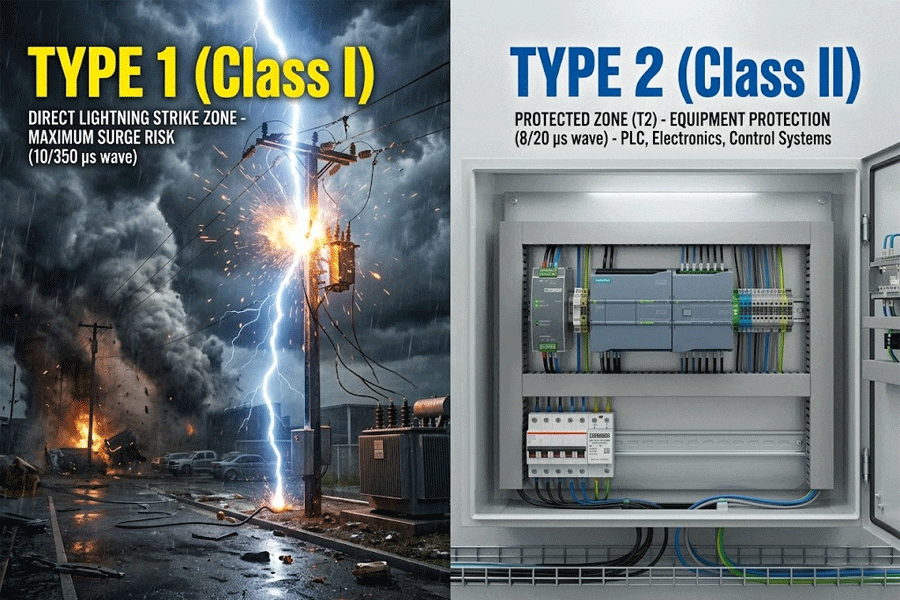
The core difference between Type 1 (Class I) and Type 2 (Class II) SPDs lies in the amount of energy they can safely absorb. To understand this, we must look at the standard test waveforms defined by IEC 61643-11.
Type 1 (Class I): The Heavyweight Bouncer (10/350 µs)
- The Threat: Direct lightning strikes to the building or overhead power lines.
- The Waveform (10/350 µs): This waveform represents a massive, sustained injection of energy. It reaches its peak current in 10 microseconds and takes 350 microseconds to decay. The destructive thermal energy of a 10/350 µs pulse is roughly 20 times greater than that of a standard Type 2 surge.
- The Role: Type 1 SPDs are the first line of defense. They are built with heavy-duty components (like high-energy MOVs or Spark Gaps) designed to absorb and ground the massive brute force of a direct lightning strike before it enters the facility.
Type 2 (Class II): The Precision Guard (8/20 µs)
- The Threat: Indirect lightning strikes (electromagnetic induction) and internal switching surges from heavy machinery (like motors or HVAC compressors).
- The Waveform (8/20 µs): This waveform represents a fast, sharp voltage spike. It reaches its peak in just 8 microseconds and decays in 20. While the voltage is high, the overall thermal energy is much lower than a direct strike.
- The Role: Type 2 SPDs are the second line of defense. They clean up the residual voltage let through by the Type 1 SPD and clamp internal switching transients to protect sensitive PLCs, computers, and VFDs.
Lightning Protection Zones (LPZ): Where Do They Go?
In professional electrical engineering, you do not choose between Type 1 and Type 2. Instead, you use them together in a strategy called Cascading Protection, based on Lightning Protection Zones (LPZ).
- Main Distribution Board (MDB) → LPZ 0 to LPZ 1: This is where the external power grid enters the building. Because this point is vulnerable to direct lightning currents, you must install a Type 1 SPD here.
- Sub Distribution Boards (SDB) → LPZ 1 to LPZ 2: These are the electrical panels located deeper inside the building, on different floors or near specific machinery. By the time a surge reaches here, the Type 1 has absorbed the bulk of the energy. Therefore, you install Type 2 SPDs here to handle the residual spikes.
The Buyer’s Checklist: Do You Need Type 1, Type 2, or Both?
Stop guessing. Use this rapid procurement checklist to determine exactly what you need to order for your facility:
| Project Condition | Recommended SPD Configuration |
|---|---|
| 🌩️ Does the building have an external Lightning Protection System (LPS / Lightning Rod)? | Type 1 (Mandatory at main entrance) + Type 2 (at sub-boards) |
| 🏭 Is the facility supplied by overhead power lines? | Type 1 (Mandatory at main entrance) + Type 2 (at sub-boards) |
| 🏢 Is it a commercial building supplied by underground cables (No external LPS)? | Type 2 (Sufficient for main and sub-boards) |
| 🔌 Are you protecting an industrial Motor Control Center (MCC) deep inside a factory? | Type 2 (To handle internal motor switching surges) |
| 🏠 Are you upgrading a standard residential consumer unit (underground grid)? | Type 2 (Sufficient for household protection) |
The Installation Headache: Cascading Distance vs. Combined Type 1+2 SPDs
If your checklist requires both Type 1 and Type 2 protection, you face a notorious installation headache: Decoupling Distance.
According to traditional engineering standards, if you install a separate Type 1 and Type 2 SPD, there must be at least 10 meters of cable length between them to ensure they coordinate properly. If they are installed too close together, the Type 2 will try to absorb the massive Type 1 surge and instantly explode.
But what if your main switch room is too small to provide 10 meters of cable separation?
The Ultimate Solution: Type 1+2 Combined SPDs
Instead of buying separate units and worrying about complex cable calculations, smart EPC contractors and panel builders are switching to Class I+II (Type 1+2) Combined SPDs.
These advanced units house both heavy-duty Type 1 discharge capabilities (10/350 µs) and precision Type 2 clamping capabilities (8/20 µs) inside a single, compact DIN-rail module.
- Zero distance required: Internal coordination is already done at the factory.
- Saves space: Frees up critical DIN rail real estate in your distribution board.
- Lower total cost of ownership: Reduces installation time and wiring complexity.
Partnering with a Direct OEM Manufacturer for Your SPD Projects
Whether you need bulk standard Type 2 units for residential projects, or heavy-duty Type 1+2 combined SPDs for critical industrial infrastructure, buying direct from a verified OEM manufacturer is the smartest procurement strategy.
We supply a complete ecosystem of surge protection. Our SPDs utilize advanced, high-energy MOV technology—eliminating the follow-current issues of old spark-gap designs—while offering unbeatable B2B wholesale pricing.
Don’t forget the backup! Every SPD requires upstream short-circuit protection. Ensure your BOM includes the matching [Miniature Circuit Breakers (MCB)] (link to your MCB category) to safely coordinate with your new surge protectors.
Ready to finalize your procurement list? Review our full technical catalog or [Contact our Engineering Sales Team today] (link to Contact Us page) to get customized SPD sizing advice and a highly competitive wholesale quotation for your next project.