In modern industrial manufacturing, the most expensive element is rarely the machinery itself—it is the catastrophic cost of unexpected downtime. When a critical production line grinds to a halt, every single minute translates to thousands of dollars in lost revenue, missed deadlines, and wasted labor.
One of the most common, yet frequently underestimated, causes of these sudden electrical failures is transient overvoltages (power surges). Without robust, industrial-grade AC surge protection, your facility’s most expensive components—such as Variable Frequency Drives (VFDs), Programmable Logic Controllers (PLCs), and precision servo motors—are essentially sitting ducks. A single massive voltage spike can instantly fry their sensitive motherboards, paralyzing your entire operation.
However, treating industrial surge protection as an afterthought or relying on standard commercial-grade protectors is a recipe for disaster. The harsh, fluctuating electrical environment of a factory requires a fundamentally different approach.
Whether you are a panel builder designing a new Motor Control Center (MCC), an EPC contractor, or a plant manager upgrading your main electrical switchboards, selecting the correct heavy-duty protection is non-negotiable. In this comprehensive B2B guide, we will dive deep into how to properly size an AC Surge Protective Device (SPD) for industrial distribution boards. We will uncover why standard 275V SPDs catch fire in factories, how to configure 3-phase protection, and the best practices for building a bulletproof, zero-downtime control panel.
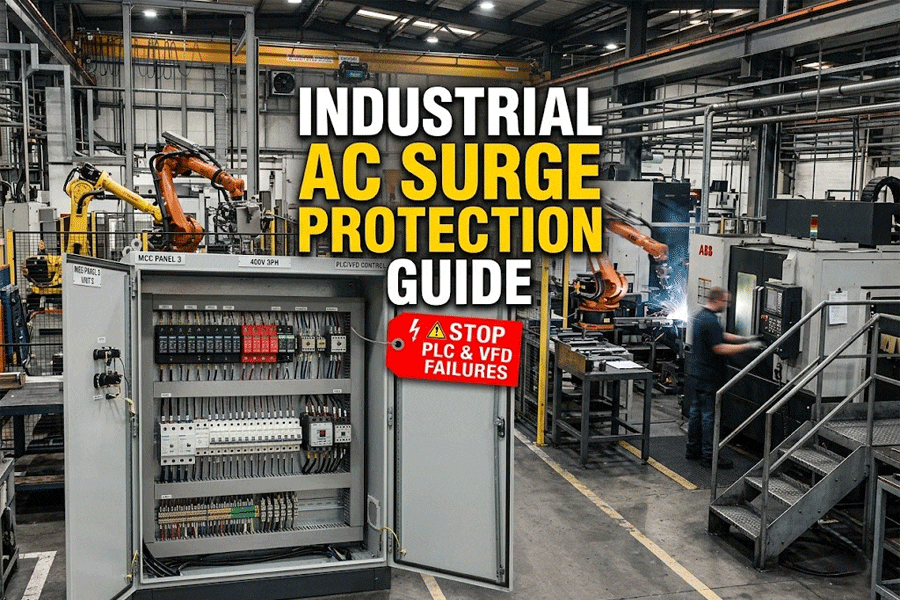
The Hidden Threat: Why Your Industrial Plant Needs AC Surge Protection
When facility managers and maintenance engineers think of surge protection, they typically picture a massive thunderstorm and a direct lightning strike hitting the roof. While external lightning strikes are undeniably devastating, they only account for about 20% of all transient overvoltage events.
The real, everyday danger to your automated production lines comes from inside your own building.
The 80/20 Rule: The Danger of Internal Switching Surges
In the industrial sector, the 80/20 rule dictates that 80% of all power surges are generated internally. Modern manufacturing plants are packed with massive inductive loads and high-power machinery.
Every time a heavy-duty CNC lathe spins up, an overhead crane motor brakes suddenly, or a facility transformer switches power loads, it creates a violent disruption in the electrical current. This rapid switching sends high-energy micro-surges cascading backwards through your AC distribution boards and into your delicate control circuits.
The “Electronic Rust” Destroying Your VFDs
Unlike a direct lightning strike that instantly melts a control panel, these internal switching surges are often silent and invisible. However, they act like “electronic rust.” Day after day, hour after hour, these continuous minor voltage spikes stress the electrical system. They slowly degrade the microscopic insulation inside your AC contactor coils, weaken your VFD motherboards, and degrade PLC microprocessors. Eventually, a critical automation component simply fails “without warning” during a normal Tuesday afternoon shift—resulting in thousands of dollars in unexplained downtime and emergency maintenance.
To stop this daily degradation, a single surge protector at the main facility entrance is never enough. You need a strategic, localized defense system distributed throughout your AC power network.
The 3-Stage Cascading Protection Model for Industrial Plants
Because industrial power grids are vast and complex, relying on a single surge protector at the main incoming line is a critical design flaw. A massive surge will easily bypass a single point of defense, and as we established, it does nothing to stop the internal switching surges generated deep inside your factory floors.
To build a bulletproof electrical system, international standards (IEC 61643-11) mandate a Cascading Protection Model—often referred to as defense-in-depth or Lightning Protection Zones (LPZ). This involves installing different classes of AC Surge Protective Devices at strategic points across your distribution network.
1. Type 1 SPD (Class I): The Main Gatekeeper
- Installation Point: The Main Distribution Board (MDB) or the main service entrance of the facility.
- The Mission: Type 1 SPDs are the heavy-duty bouncers of your electrical grid. They are specifically tested with a 10/350µs current waveform to withstand the raw, massive energy of a direct lightning strike. If your factory has an external lightning rod system, a Type 1 SPD is absolutely mandatory by electrical codes to prevent thousands of amps from traveling down the incoming utility lines and melting your main breakers.
2. Type 2 SPD (Class II): The Industrial Workhorse
- Installation Point: Sub-Main Distribution Boards (SMDB), Motor Control Centers (MCC), and automated machinery control panels.
- The Mission: This is the most critical and heavily utilized surge protector in any industrial setting. While the Type 1 handles external lightning, the Type 2 DIN-rail AC SPD is engineered to absorb the highly frequent, internal switching surges and indirect lightning strikes (tested with an 8/20µs waveform).
- Why You Need Multiple: Because internal surges degrade equipment locally, every single control panel housing expensive PLCs, VFDs, or servo drives must have its own dedicated Type 2 SPD. For panel builders and maintenance teams, standardizing on a reliable, pluggable Type 2 SPD is the most cost-effective way to ensure zero downtime across the entire plant.
3. Type 3 SPD (Class III): Point-of-Use Filtration
- Installation Point: Installed directly adjacent to ultra-sensitive terminal equipment (like industrial computers or specific precision sensors).
- The Mission: Type 3 SPDs have a very low discharge capacity. They are designed only to clean up the tiny, residual voltage spikes that manage to slip past the Type 1 and Type 2 defenders. They must never be used alone and should always be installed downstream of a robust Type 2 SPD.
How to Size an AC Surge Protector: 3 Critical Industrial Parameters
Sizing an AC Surge Protective Device is where the most catastrophic—and costly—engineering mistakes happen. You cannot simply pull a generic surge protector off the shelf and install it in a heavy-duty Motor Control Center (MCC).
When evaluating an SPD for an industrial distribution board, you must look closely at the printed label and understand these three critical parameters:
1. The Voltage Trap: Why a 275V SPD Will Burn Out in a Factory
- The Parameter: Uc (Maximum Continuous Operating Voltage). This is the absolute maximum voltage the SPD can handle continuously without triggering its internal MOV (Metal Oxide Varistor) to degrade or short-circuit.
- The Industrial Reality: In a standard commercial or residential setting, the grid is relatively stable, making a standard Uc 275V AC surge protector perfectly adequate. However, industrial environments are notoriously unstable. When heavy machinery cycles on and off, or during night shifts when grid demand drops, the factory’s baseline voltage can easily swell above 275V.
- The Danger: If the continuous grid voltage exceeds the SPD’s Uc rating, the MOV will overheat, thermally run away, and potentially catch fire. This is a common, disastrous mistake made by procurement managers trying to save money on cheaper, commercial-grade components.
- The Solution: For true industrial resilience, you must specify a heavy-duty protector with a Uc rating of 385V AC or 420V AC. This high-tolerance buffer ensures the SPD ignores normal industrial voltage fluctuations and only activates when a true, dangerous transient surge hits.
2. Matching the Grid: 3-Phase and Pole Configurations
- The Parameter: Unlike homes, factories run on 3-phase power to drive large motors and VFDs. Your AC SPD must structurally match the facility’s grounding system.
- The Solution: For standard 3-phase distribution boards (typically TN-S or TT earthing systems), a 4 Pole AC SPD or a 3P+N (Three-Phase + Neutral) surge arrester is strictly required. The 3P+N configuration provides comprehensive protection across all lines, safely discharging transient spikes from Phase to Neutral, and from Neutral to Ground (PE), ensuring your expensive 3-phase equipment is completely shielded from all angles.
3. Discharge Capacity: In and Imax for Heavy-Duty Applications
- The Parameter: How much raw energy can the SPD absorb before it sacrifices itself? This is measured in In (Nominal Discharge Current) and Imax (Maximum Discharge Current), tested under an 8/20µs waveform for Type 2 devices.
- The Solution: * In (The Cruising Speed): A standard industrial Type 2 SPD must have a minimum In of 20kA. This guarantees the device can repeatedly absorb typical, everyday internal switching surges from your CNC machines and air compressors without needing replacement.
- Imax (The Airbag): The absolute maximum, worst-case surge it can handle exactly once. For robust distribution boards, Imax 40kA is the baseline. However, for primary Sub-Main Distribution Boards (SMDB) in high-exposure areas, upgrading to a heavy-duty 60kA or 100kA AC SPD is a highly recommended insurance policy for your multimillion-dollar production line.
Best Practices: Building a Bulletproof Industrial Distribution Board
Even the most robust, heavy-duty 4-pole AC SPD is rendered useless—or worse, becomes a severe safety hazard—if it is installed incorrectly or left isolated. To truly protect your PLCs, VFDs, and CNC machinery from all electrical anomalies, you must build a comprehensive power quality ecosystem inside your 35mm DIN-rail enclosure.
Here is the engineering blueprint for a modern, bulletproof Motor Control Center (MCC):
1. The Golden Rule: Always Install Backup Protection (MCB)
One of the most dangerous installation errors is wiring an AC surge protector directly to the main busbar without upstream protection. When an SPD reaches the end of its lifespan or absorbs a catastrophic surge beyond its Imax rating, its internal MOV degrades and fails in a “short-circuit” state. If left unchecked, this short circuit will melt the distribution board wiring and start an electrical fire.
The Solution: You must always install a dedicated [Miniature Circuit Breaker (MCB)] (link to your MCB product page) or a Molded Case Circuit Breaker (MCCB) in series upstream of the SPD. This backup protection ensures that if the SPD sacrifices itself, the MCB will instantly trip, safely disconnecting the failed surge protector from the grid while keeping the rest of the factory running safely.
2. Pair with 3-Phase Over and Under Voltage Protectors
It is crucial to understand that an SPD only clamps microsecond transient spikes (like lightning or switching surges). It does not protect your industrial motors from sustained grid fluctuations, such as a continuous 380V supply dropping to 300V (brownout) or spiking to 450V for several minutes, nor does it protect against phase loss.
The Solution: For complete motor and VFD protection, install a [3-Phase Over and Under Voltage Protector] (link to your voltage protector page) alongside your SPD. These smart relays monitor the continuous grid voltage in real-time. If they detect a sustained anomaly or a missing phase, they automatically cut the power to prevent your AC contactor coils from burning out, instantly reconnecting once the industrial grid stabilizes.
3. Monitor Power Quality with a 3-Phase Energy Meter
Modern industrial facilities demand data. You cannot manage what you do not measure. The Solution: Integrating a [3-Phase DIN Rail Energy Meter] (link to your energy meter page) directly next to your protective devices transforms a standard panel into a smart sub-metering hub. This allows facility managers to track real-time kWh consumption of specific automated production lines, identify inefficient heavy machinery, and accurately allocate energy costs across different factory departments.
4. Leverage Smart Features: Remote Signaling & Pluggable Modules
Industrial control panels are often locked and unattended. If a surge protector fails, you cannot rely on a maintenance worker walking by to notice it. Always specify SPDs that feature a pluggable modular design and a remote signaling contact (alarm terminal).
- Visual Status Window: Turns from green to red when the module is depleted, allowing for hot-swapping (replacing the cartridge without shutting off the main power).
- Remote Signaling: The built-in dry contact can be wired directly to the factory’s central PLC or SCADA system. If the SPD fails at 2:00 AM, it instantly sends a digital alert to the control room, ensuring your facility is never left unprotected.
Sourcing Reliable AC SPDs from China: A Procurement Guide
China is the undisputed global manufacturing hub for low-voltage electrical components. However, for procurement managers and EPC contractors, navigating the sea of suppliers can be treacherous. The market is flooded with dangerously cheap, commercial-grade surge protectors masquerading as industrial heavy-duty equipment. These units often use undersized MOVs or fake certification stickers, which will inevitably fail—or catch fire—when a real industrial surge hits your MCC panel.
When sourcing 3-phase AC SPDs in bulk for your distribution boards, look beyond the initial price tag. Here is your engineering checklist for identifying a reliable manufacturing partner:
1. Demand True IEC 61643-11 Compliance
Never take a simple “CE” sticker at face value. A legitimate industrial AC surge protector must explicitly comply with the IEC 61643-11 standard. Request the actual laboratory test reports. A high-quality OEM manufacturer will transparently provide documentation proving their devices have passed rigorous 8/20µs (for Type 2) and 10/350µs (for Type 1) current waveform testing.
2. Inspect the Housing: V0 Flame-Retardant Materials
An industrial surge protector handles massive amounts of raw energy, making heat dissipation and safety critical. Ask the supplier about their plastic casing specifications. A reliable factory will only use V0-grade flame-retardant materials. If a massive grid anomaly causes the internal MOV to fail and overheat, the housing must melt to disconnect the circuit, but it must never sustain a flame inside your distribution board.
3. Evaluate OEM/ODM and Supply Chain Capabilities
If you are a panel builder or an electrical distributor, your supplier should offer more than just off-the-shelf parts. Look for a direct factory that supports comprehensive OEM services—such as custom logo silk-printing, specific housing colors, and tailored voltage ratings (e.g., specific Uc 385V or 420V requests). Furthermore, partnering with a direct manufacturer guarantees stable lead times, rigorous QA/QC processes, and highly competitive wholesale pricing compared to dealing with trading companies.
Frequently Asked Questions (FAQs)
Q: What is the difference between a surge protector and a circuit breaker? A: A circuit breaker (MCB/MCCB) protects your wiring from sustained overcurrents and short circuits by tripping and cutting the power. A Surge Protective Device (SPD) protects sensitive electronics from microsecond voltage spikes by diverting the excess voltage to the ground. You need both for a safe distribution board.
Q: Can I install a Type 2 SPD without a Type 1 SPD? A: Yes, if your facility does not have an external lightning protection system (lightning rod) and is not at risk of direct strikes, a Type 2 SPD installed at the main and sub-distribution boards is sufficient to handle induced lightning and internal switching surges.
Q: How often do industrial surge protectors need to be replaced? A: Quality SPDs do not have a strict expiration date; their lifespan depends on the frequency and severity of the surges they absorb. You only need to replace the pluggable module when the visual status window turns from green to red, indicating the internal MOV has been depleted.
Secure Your Industrial Control Panels Today
In industrial automation, hope is not a strategy. Don’t leave your expensive PLCs, VFDs, and servo motors vulnerable to unpredictable transient overvoltages. Whether you are building a new Motor Control Center, upgrading factory switchboards, or looking for a reliable OEM manufacturing partner for low-voltage components, choosing the right protection is critical.
Ready to eliminate downtime and upgrade your power quality solutions? [Contact Our Engineering Team Today] to discuss your specific AC distribution panel requirements and get a competitive B2B wholesale quote.