
Picture this: You are standing in front of an industrial control panel. The power grid seems perfectly fine, the lights aren’t flickering, yet the expensive 3-phase water pump or commercial chiller keeps randomly shutting down. The maintenance team is frustrated, and production is halting.
If there is no genuine mechanical fault or permanent phase loss, you are likely dealing with the most common headache in motor control: Nuisance Tripping. And in 90% of these cases, the culprit is a poorly configured trip delay setting on your phase monitor.
Understanding how to correctly adjust the trip delay on a 3 phase voltage protector is the difference between a resilient, robust control system and a highly unstable one. Let’s dive into the engineering behind it and find the absolute “sweet spot” for your equipment.
What is Trip Delay? (And Why “0 Seconds” is a Terrible Idea)
Trip Delay (sometimes called fault delay or tripping time) is the specific amount of time the protection relay waits after detecting a voltage anomaly (like under-voltage, over-voltage, or unbalance) before it actually opens its internal contacts to shut down the system.
Many junior panel builders operate under a dangerous misconception: “I want maximum protection for my motor, so I will set the trip delay to 0 or 0.1 seconds.” This is a terrible idea. The real-world industrial power grid is incredibly “dirty.” It is constantly bombarded with micro-fluctuations, transient spikes, and split-second voltage sags that are completely harmless to a heavy-duty motor. If you set your trip delay to 0 seconds, you turn your over under voltage relay setting into a nervous wreck, tripping the system at the slightest, harmless electrical hiccup.
The Inrush Current and “Nuisance Tripping” Problem
To understand why we need a delay, we must look at what happens when large machinery starts up.
When a neighboring 100kW heavy-duty motor or a massive factory crane initiates its startup sequence, it pulls an enormous amount of power—often 6 to 8 times its normal running current. This is known as Inrush Current.
This massive localized power draw causes the entire local grid’s voltage to momentarily sag (a Voltage Dip) for roughly 0.5 to 1.5 seconds. If your 3-phase voltage protector is set to a 0.5-second trip delay, it will interpret this neighbor’s startup as a dangerous under-voltage event. It will unnecessarily shut down your perfectly healthy motor. This is the textbook definition of nuisance tripping.
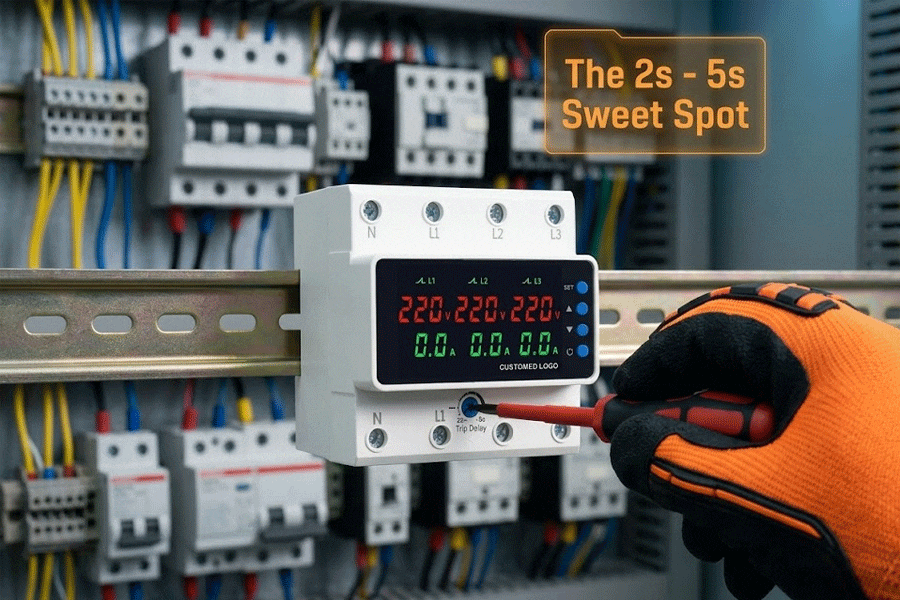
Finding the Sweet Spot: The 2 to 5 Second Rule
So, how long should the trip delay be? You need a duration long enough to “ride through” harmless grid transients, but short enough to execute a shutdown before a genuine fault (like a complete phase loss) can melt the motor’s windings.
For standard commercial HVAC compressors, submersible pumps, and industrial fans, the golden engineering standard is the 2 to 5 Second Rule.
- 2 to 3 Seconds: Ideal for highly sensitive equipment or areas with relatively stable grids. It easily filters out the 1-second inrush current dips from nearby machinery.
- 4 to 5 Seconds: Recommended for heavy industrial environments with very noisy power grids.
Why is 5 seconds safe? Because if a true “single-phasing” (phase loss) event occurs, it typically takes anywhere from 15 seconds to a couple of minutes for the extreme negative sequence currents to generate enough heat to destroy the motor insulation. Tripping at the 3 or 5-second mark provides absolute, guaranteed protection without the headache of false alarms.
Don’t Confuse Trip Delay with Auto-Recovery Delay
A critical mistake in panel configuration is confusing Trip Delay with Recovery Delay (or Auto-Restart Delay). They do two completely different jobs:
- Trip Delay: “How long should I wait to shut down when I see a problem?” (Filters out noise. Set to 2-5 seconds).
- Auto-Recovery Delay: “How long should I wait to turn back on after the grid is healthy again?” (Protects machinery from short-cycling).
For instance, a commercial chiller requires a 3 to 5-minute Auto-Recovery Delay to allow high-pressure refrigerant to equalize before the compressor restarts. Never mix these two settings up on your digital phase relay!
Upgrade Your Panel: The Adjustable Digital Phase Relay
If you are constantly battling unexplained shutdowns, check your current protection hardware. Cheap, outdated relays often have fixed trip delays (hardwired at 0.5s) or lack precision.
To build a truly resilient motor control center (MCC), upgrade to an adjustable digital phase relay. These premium components feature an LCD screen and precise digital inputs, allowing your engineers to dial in the exact trip delay (e.g., exactly 3.5 seconds) required for your specific site conditions.
A Crucial System Note: Your phase protector is only as good as the hardware it controls. The protector’s small internal relay relies on a heavy-duty magnetic contactor to actually cut the main motor power. Ensure your control panel pairs a high-quality adjustable protector with industrial-grade 3-phase magnetic contactors that won’t chatter or drop out prematurely during minor voltage sags.
Stop letting harmless grid noise shut down your production line. Dial in your trip delay, upgrade your control panel components, and secure your industrial assets today.