
If you walk the floor of an industrial plant, you might occasionally find a motor that is humming loudly and feels dangerously hot to the touch, even though it isn’t carrying a heavy mechanical load. You check the breaker—it hasn’t tripped. You check for a complete phase loss—all three lines are live. So, what is silently baking your equipment?
The answer is often voltage unbalance.
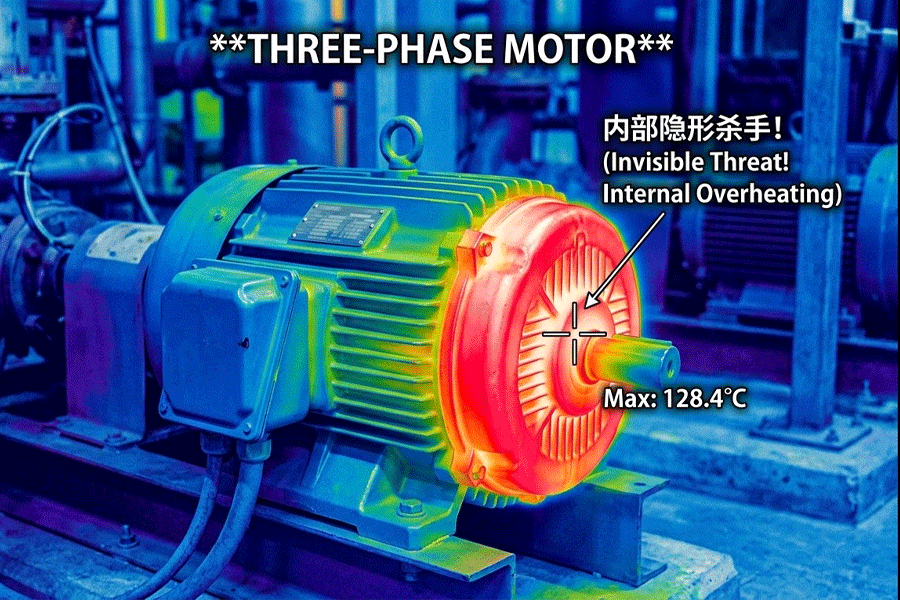
While a complete phase loss (single-phasing) is a sudden, catastrophic event that kills a motor quickly, voltage unbalance is a chronic poison. The motor keeps running, but the internal temperature silently skyrockets, slowly degrading the winding insulation until the motor suffers a premature, unexpected death. Let’s break down exactly what causes this phenomenon, how to perform a quick current unbalance calculation, and how to stop it from destroying your assets.
What Causes Voltage Unbalance in the Grid?
In a perfect engineering world, a 3-phase power supply delivers exactly the same voltage across Line 1, Line 2, and Line 3. However, the real-world utility grid is far from perfect.
Voltage unbalance occurs when the voltages of the three phases differ from one another. But why does this happen? It is rarely the fault of the motor itself. The most common culprits include:
- Uneven Single-Phase Loads: The most frequent cause. If a facility connects too many single-phase loads (like office lighting, heavy HVAC units, or computers) to just one phase of the 3-phase system, it drags the voltage of that specific line down.
- Aging Utility Transformers: A degraded or malfunctioning transformer bank on the utility pole can output asymmetrical voltages.
- Heavy Equipment Nearby: Large single-phase industrial equipment, such as heavy-duty welding machines, drawing massive power intermittently.
The NEMA Rule: The Deadly “2% = 10%” Formula
To understand why a slight voltage difference is so destructive, we must look at the math. The National Electrical Manufacturers Association (NEMA) has a golden rule that every panel builder must memorize: Every 1% of voltage unbalance results in a 6% to 10% current unbalance.
Let’s do a quick current unbalance calculation with a real-world scenario. Imagine your grid measures:
- L1 = 380V
- L2 = 380V
- L3 = 365V
The average voltage is 375V. The maximum deviation from the average is 10V (375V – 365V).
- (10V / 375V) × 100 = 2.6% Voltage Unbalance.
A 2.6% voltage difference seems harmless, right? Wrong. According to the NEMA rule, this will cause roughly a 15% to 26% current unbalance inside the motor!
This disproportionate current surge creates a highly destructive physical phenomenon called Negative Sequence Current. This reverse-rotating magnetic field fights against the motor’s normal rotation. It acts exactly like a microwave, generating massive amounts of localized friction and heat directly inside the stator windings.
The Thermal Reality: Half the Life for a Few Degrees
The direct result of negative sequence currents is severe 3 phase motor overheating.
In the electrical engineering world, there is another famous law known as the “10-Degree Rule” (based on the Arrhenius equation). It states that for every 10°C (18°F) rise above the motor’s rated operating temperature, the life of the winding insulation is cut entirely in half.
This is exactly why motors often experience mysterious, nuisance tripping on their thermal overloads during hot summer days. The ambient heat combined with the internal baking caused by voltage unbalance pushes the motor over its thermal limit. Even if the overload relay eventually trips, the continuous cycle of overheating has already crystallized the varnish on the copper windings, guaranteeing a premature short circuit.
How to Stop It: The Adjustable Phase Monitor Relay
Standard bimetallic thermal overload relays are current-dependent. They are notoriously slow to react and often fail to detect the complex, localized heat buildup caused by negative sequence currents before permanent insulation damage occurs.
The only way to actively defend against this chronic threat is by monitoring the power before it damages the motor. This requires integrating a dedicated adjustable phase monitor relay into your motor control panel.
Unlike standard breakers, a digital phase monitor constantly measures the exact voltage symmetry across all three lines.
Why must it be “Adjustable”? Not all motors have the same tolerance. A rugged ventilation fan might handle a 5% unbalance safely, while a highly sensitive, $10,000 commercial chiller compressor might start melting at just 3%. An adjustable phase monitor relay allows the engineer to dial in the exact trip threshold (e.g., setting the unbalance limit to exactly 4%). The millisecond the grid crosses this threshold, the relay drops the contactor, instantly saving the motor from a slow, agonizing thermal death.
Stop letting dirty utility power quietly consume your maintenance budget. Upgrade your control panels with adjustable phase protection and eliminate unexplained motor burnouts for good.