
Inside a modern control panel, real estate is incredibly expensive. Snapping a DIN rail energy meter onto a standard 35mm rail takes a matter of seconds. But ensuring that meter can reliably transmit critical power data through a maze of Variable Frequency Drives (VFDs), contactors, and heavy machinery? That is a completely different challenge.
For panel builders, system integrators, and facility managers, the communication protocol isn’t just a technical spec—it is the lifeline of the entire energy management system. Faced with acronyms and options like RS485, Modbus RTU, and WiFi, making the wrong choice doesn’t just mean a few dropped data packets. It means constant “equipment offline” alerts, frustrating blind spots in your SCADA system, and endless, costly troubleshooting trips to the factory floor.
This guide is designed to cut through the marketing noise. We are going to break down the fundamental differences between these communication standards, explain why consumer-grade wireless solutions often fail in heavy industry, and show you exactly how to choose the right smart meter for your next industrial automation project.
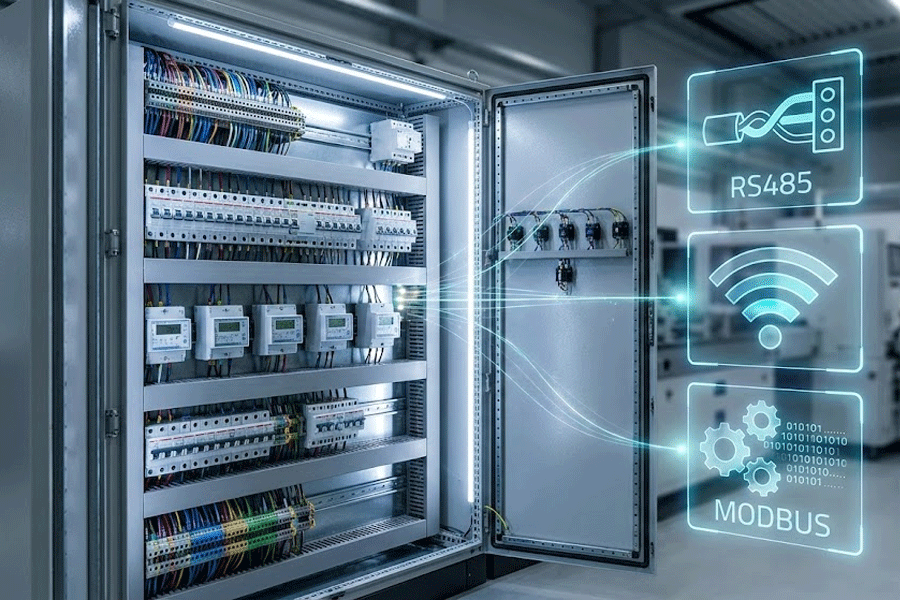
Demystifying the Basics: RS485 vs. Modbus RTU
If you have ever found yourself using the terms “RS485” and “Modbus” interchangeably, you are certainly not alone. It is one of the most common points of confusion in industrial procurement and system design. However, understanding the difference between the two is the crucial first step in selecting the right equipment.
To put it simply: one is the hardware, and the other is the software.
Think of RS485 as the physical infrastructure—the highway. It is a serial communication standard that defines the electrical characteristics, the voltage levels, and the actual physical wires (typically a shielded twisted pair, often referred to as A and B lines) that connect your devices. RS485 dictates the physical rules, such as how far the electrical signal can travel without degrading and how many meters can be physically wired together on a single daisy chain.
On the other hand, Modbus RTU is the language spoken on that highway. It is the application protocol—the set of logical rules that dictates how data is formatted, organized, and requested. If RS485 is the highway, Modbus RTU is the fleet of delivery trucks driving on it, carrying the actual payload: the real-time kilowatt-hour (kWh), voltage, and current data from your meter to your controller.
When you are sourcing an industrial-grade DIN rail energy meter, you are almost always looking for a device that utilizes both. The specification sheet will typically read: “Communication: RS485 interface, Modbus RTU protocol.” You need the robust, physical wiring standard of RS485 to survive the harsh electrical environment of a factory floor, combined with the universal, open-source language of Modbus RTU so that your PLC (Programmable Logic Controller) or SCADA system can effortlessly read and interpret the energy data.
WiFi DIN Rail Meters: Convenient, but Are They Industrial-Grade?
In the age of IoT (Internet of Things), a WiFi DIN rail meter sounds like the ultimate dream for any technician. The pitch is incredibly appealing: snap the meter onto the 35mm rail, connect it to the local wireless network, and instantly stream real-time energy data to a cloud dashboard or smartphone app—all without running a single communication cable.
For smart homes, residential sub-metering, or light commercial buildings using plastic enclosures, WiFi meters are fantastic, cost-effective solutions. However, when you step into the world of industrial automation, the reality is starkly different.
The Faraday Cage Effect
The first major hurdle is physics. Most industrial-grade distribution boxes and control panels are constructed from solid, grounded steel to protect the internal components. When you place a wireless transmitter inside a sealed metal cabinet, you unintentionally create a perfect Faraday cage. The metal enclosure absorbs and blocks the RF signals, choking your WiFi connection. The result? Weak signal strength, frequent drop-outs, and unrecorded energy consumption data.
The Invisible Enemy: EMI
Even if your signal manages to escape the metal box, the factory floor is a notoriously hostile environment for wireless frequencies. High-power industrial equipment—such as Variable Frequency Drives (VFDs), large induction motors, and arc welders—generates massive amounts of Electromagnetic Interference (EMI). This electrical “noise” can easily scramble or drown out a standard 2.4GHz WiFi signal, leading to packet loss and communication timeouts with your monitoring software.
The Pro-Tip for Wireless Needs
Does this mean you can never use WiFi in a factory? Not necessarily. If you are retrofitting an older facility where pulling new communication cables is simply impossible, you cannot rely on a standard smart meter with an internal antenna. You must specifically source a DIN rail meter equipped with an external magnetic antenna. This allows you to mount the antenna on the outside of the metal control panel, bypassing the Faraday cage and securing a much more stable connection to your local network.
Why RS485 Modbus is the Gold Standard for Industrial Control Panels
While wireless technology has its place, the heavy-duty industrial world still runs on wires. When uptime is non-negotiable and data accuracy dictates your billing or operational efficiency, the combination of an RS485 physical layer and the Modbus RTU protocol remains the undisputed champion. Here is exactly why seasoned electrical engineers refuse to compromise on this standard.
Bulletproof Immunity to Electrical Noise (EMI)
Unlike standard Ethernet cables or wireless signals, RS485 utilizes balanced, differential signaling over a shielded twisted-pair cable. This means that if a massive induction motor starts up nearby and generates a spike of electromagnetic interference, the noise affects both wires equally. The receiving device simply calculates the difference between the two voltages, effectively canceling out the interference. This makes an RS485 connection incredibly resilient, allowing it to transmit accurate power data over distances up to 1,200 meters (4,000 feet) right through the heart of a noisy factory.
The Elegance of Daisy-Chain Topology
Space inside a control panel is a premium commodity. If you need to monitor 10 different circuits in a commercial building or factory, running 10 separate Ethernet cables back to a central switch is an expensive, cluttered nightmare. RS485 solves this through a “daisy-chain” topology.
You can wire the A and B communication lines from your master controller to the first meter, then from the first meter to the second, and so on. A standard RS485 bus can support up to 32 3-phase DIN rail energy meters (and up to 256 with repeaters) on a single two-wire cable. This dramatically reduces material costs, simplifies the internal wiring of your distribution box, and leaves more room on the 35mm DIN rail for your circuit breakers and contactors.
Seamless PLC and SCADA Integration
Hardware reliability is only half the battle; the data still needs to be understood by your system. This is where Modbus RTU shines. Developed in the 1970s, it is the most widely adopted, open-source industrial protocol in the world. It is the native language of almost every major PLC (Programmable Logic Controller), HMI, and SCADA system on the market.
There are no proprietary cloud APIs to decipher, no recurring software subscription fees, and no vendor lock-in. You simply consult the manufacturer’s datasheet, input the Modbus holding register addresses for the data points you need (like voltage, current, active power, or power factor), and your system begins reading the data instantly. It is the definition of industrial “plug-and-play.”
Best Practices: How to Wire an RS485 DIN Rail Meter
Even the most robust communication protocol in the world will fail if the physical installation is sloppy. The majority of “defective” Modbus meters we see are actually the victims of easily preventable wiring errors inside the distribution box.
If you are setting up a daisy-chain network of DIN rail energy meters for your facility, follow these three essential best practices to ensure a flawless connection to your PLC or gateway.
Step 1: Strategic Placement on the 35mm Rail Your meter is designed to snap effortlessly onto a standard 35mm DIN rail. For safety and compliance, it should be positioned immediately adjacent to a dedicated Miniature Circuit Breaker (MCB). Not only does the MCB protect the meter from dangerous overcurrents and short circuits, but keeping the power source physically close to the meter keeps your high-voltage wiring neat and minimizes the risk of accidental contact during future maintenance.
Step 2: Bulletproof Your Comm Lines When wiring the RS485 network, always use a shielded twisted-pair cable. Strip the wires carefully and terminate them using high-quality industrial electrical terminals (ferrules). Never insert bare, frayed copper wire directly into the RS485 ports (usually labeled A/D+ and B/D-). A single stray strand of copper bridging the A and B terminals will short out the entire communication bus, bringing down your whole network. Secure, crimped terminals are non-negotiable for long-term stability in vibrating industrial environments.
Step 3: The 120-Ohm Termination Resistor This is the “secret” that separates novice installers from seasoned pros. An RS485 signal travels down the wire at high speeds. When it hits the end of the cable, it can “bounce” back, creating an echo (signal reflection) that corrupts the data packets. To absorb this echo, you must install a 120-ohm termination resistor directly across the A and B terminals of the very last meter in your daisy chain.
⚠️ Troubleshooting 101: Top 3 Modbus Connection Failures If your PLC or SCADA system cannot read the meter, check these three culprits before you assume the hardware is broken:
- Reversed A/B Wires: Different manufacturers sometimes label their Tx/Rx pins differently. If the connection fails, simply try swapping the A and B wires. You won’t damage the equipment, and 50% of the time, this instantly solves the issue.
- Mismatched Baud Rates: The meter and the master controller must speak at the same speed. If your PLC is listening at 19200 bps, but the meter is broadcasting at its factory default of 9600 bps, they will never connect.
- Duplicate Slave IDs: In a Modbus RTU network, every single meter must have a unique numerical address (from 1 to 247). If two meters on the same rail are both assigned “ID 1”, the resulting data collision will crash the bus.
The Ultimate Compromise: The Hybrid IoT Solution
So, are you forced to choose between the rock-solid reliability of an RS485 network and the modern convenience of wireless cloud monitoring? Not at all. For cutting-edge industrial facilities, the best approach is a hybrid architecture.
Instead of outfitting every single meter with a vulnerable WiFi chip, seasoned system integrators wire all their DIN rail energy meters together inside the control panel using a secure RS485 daisy chain. Then, they run that single master communication line into an IoT Edge Gateway (an RS485-to-WiFi/4G converter).
This gateway is installed at the edge of the panel—often with an external antenna protruding from the metal enclosure. This architecture gives you the best of both worlds: bulletproof, EMI-resistant data collection inside the harsh factory environment, combined with seamless, wireless data transmission to your centralized Energy Management System (EMS) or cloud dashboard.
Conclusion: Sourcing for Your Next Automation Project
When designing a control panel or distribution box for an international project, the communication protocol is just the beginning. Whether you are exporting automated machinery or upgrading a commercial building’s power infrastructure, you need components that guarantee both data accuracy and operational safety. Always ensure that the meters you source carry the necessary international certifications, such as CE, RoHS, or MID compliance, to avoid regulatory headaches across borders.
Building a robust industrial system requires a complete ecosystem. It is not just about the smart meter; it is about the high-quality low-voltage electrical components that support it. From the Miniature Circuit Breakers (MCBs) that protect your circuits to the electrical terminals that secure your Modbus network, every part matters.
Ready to upgrade your energy monitoring infrastructure? Explore our full catalog of industrial-grade DIN rail energy meters and essential control panel components designed for seamless B2B integration.