
In an industrial manufacturing plant, a motor is never just a motor; it is the heartbeat of a revenue-generating assembly line. When a heavy-duty compressor, an elevator traction machine, or a massive industrial water pump fails, the true financial loss is rarely the cost of the hardware itself. The real enemy is the devastating cost of unscheduled downtime, which can easily exceed tens of thousands of dollars per hour.
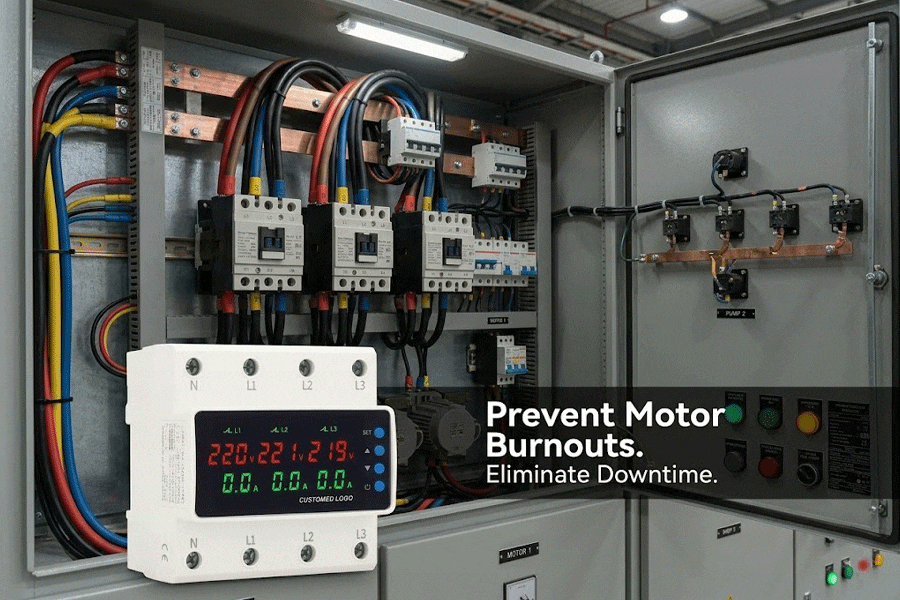
At the core of these complex Motor Control Centers (MCCs), the ultimate line of defense against severe grid quality issues is a professional 3 phase voltage protector.
Despite advancements in industrial automation, countless three-phase motors still burn out every year due to a fundamental misunderstanding of motor protection circuits. This engineering guide will break down the mechanics of the three deadliest grid faults, expose the fatal blind spots of traditional protection components, and detail how to integrate a true phase monitoring relay into your control panels to guarantee absolute reliability.
The Myth of Thermal Overloads: Why 3-Phase Motors Still Burn Out
When investigating a catastrophic motor failure, the most common question from a frustrated facility manager is: “Why didn’t the thermal overload relay trip?”
For decades, many panel builders have operated under the dangerous assumption that pairing a magnetic contactor with a Thermal Overload Relay (OLR) or a Motor Protection Circuit Breaker (MPCB) provides complete immunity against grid faults. While these devices are excellent at preventing mechanical overloads (like a jammed conveyor belt), they are fundamentally flawed when it comes to defending against the most lethal electrical fault: Single-Phasing (Phase Loss).
To understand why traditional components fail to prevent 3 phase motor burnout, we must look at the physics of a “Load-Dependent” flaw and the illusion of Back-EMF.
The “Light-Load” Single-Phasing Trap
Thermal overload relays are current-dependent. They rely on bi-metallic strips that heat up and bend when the current exceeds a set threshold. However, industrial motors frequently operate well below their maximum capacity.
Imagine a 100A rated three-phase motor currently driving a light load, drawing only 50A. Suddenly, a fuse blows upstream or a utility line snaps, causing a complete loss of Phase L1. The motor continues to spin, but the remaining two phases must now work exponentially harder, instantly drawing approximately 1.73 times the current.
- 50A × 1.73 = 86.5A.
Here lies the fatal flaw: 86.5A is a massive surge, but it is still below the 100A trip threshold of the thermal relay. The OLR remains completely blind to the fault. Meanwhile, the extreme negative sequence currents generated by the phase loss act like a microwave inside the motor, rapidly baking the winding insulation until it completely shorts out and burns.
The Back-EMF Deception (Why Cheap Relays Fail)
Even if an engineer installs a basic, low-cost phase relay, running motors present another highly deceptive physical phenomenon known as Back-Electromotive Force (Back-EMF).
When a running motor loses a phase, its spinning rotor acts as a generator. It induces a “ghost voltage” back onto the disconnected dead line. This regenerated voltage can measure up to 80% or 90% of the nominal grid voltage. A cheap voltage relay will measure this Back-EMF, assume all three phases are perfectly healthy, and fail to trip the circuit.
The Voltage-Dependent Solution
To eliminate these blind spots, modern distribution boards require a high-end, microprocessor-driven phase monitoring relay.
Unlike thermal overloads, these digital protectors are voltage-dependent and react in milliseconds (<100ms). More importantly, premium digital relays don’t just measure voltage amplitude; they measure Phase Angle Asymmetry. Even if Back-EMF generates a fake 380V on a dead line, the digital relay instantly detects that the 120-degree phase angle has shifted, immediately breaking the control circuit and saving the motor.
The 3 Deadliest Grid Faults for Industrial Motors
Even the most robust Siemens or ABB motors are completely at the mercy of the utility grid. In industrial zones, heavy machinery starting up, transformer aging, and routine utility maintenance constantly pollute the power supply.
When configuring a motor control panel, engineers must design defense mechanisms against these three specific, catastrophic grid anomalies.
1. Phase Loss (Single-Phasing): The Silent Winding Killer
Phase loss, commonly referred to as “single-phasing,” is the leading cause of three-phase motor fatalities worldwide. This occurs when one of the three power lines (L1, L2, or L3) drops dead due to a blown utility fuse, a broken overhead wire, or a severely pitted contactor inside the panel.
As established, a running motor will not immediately stop when it loses a phase. Instead, it desperately tries to maintain its mechanical torque, causing the remaining two phases to draw up to 173% of their normal running current. The motor emits a deep, unnatural humming noise while the extreme heat rapidly degrades the winding insulation.
Relying on standard breakers is a gamble. Robust single phasing motor protection requires a dedicated DIN rail phase failure relay that continuously monitors the true RMS voltage and phase angle of all three lines, cutting the control circuit the millisecond a phase drops out.
2. Phase Reversal: The Mechanical Nightmare
While phase loss destroys the electrical windings, phase reversal destroys the physical machine.
Phase reversal happens when the sequence of the incoming power lines is accidentally swapped (e.g., L1-L3-L2 instead of L1-L2-L3). This typically occurs after municipal grid repairs or when a factory switches to a backup diesel generator. When the sequence is reversed, the magnetic field inside the stator reverses, causing the motor to spin backward at full speed.
For a ventilation fan, a reversed motor is simply inefficient. But for heavy industry, it is a mechanical nightmare.
- Deep Well Pumps: A submersible water pump running backward will unscrew its own impellers, dropping them down the well and completely destroying the $10,000 pump.
- Elevators and Cranes: A reversed traction motor will cause a descending elevator cabin to violently crash into the roof, or a crane to drop its suspended load.
This is why international safety codes mandate strict phase reversal relay for elevator and hoisting applications. A phase monitoring relay acts as the ultimate gatekeeper: if the sequence is wrong, it physically prevents the main contactor from ever closing.
3. Voltage Unbalance: The Overheating Trap & VFD Vulnerability
Unlike a complete phase loss, voltage unbalance is a chronic, invisible illness. It occurs when the voltages of the three phases are unequal (e.g., L1=380V, L2=370V, L3=395V).
In the engineering world, there is a golden rule defined by NEMA standards: A mere 2% voltage unbalance leads to a massive 10% current unbalance. This disproportionate current causes severe localized overheating inside the motor, cutting the motor’s expected lifespan by more than 50%.
The VFD Protection Mandate: Modern industrial panels rely heavily on Variable Frequency Drives (VFDs) or inverters to control motor speeds. VFDs are astronomically more expensive than the motors they control, and they are incredibly sensitive to voltage unbalance. An unbalanced grid forces massive ripple currents into the VFD’s DC bus capacitors, quickly overheating and detonating the drive’s input rectifier bridge.
Because every motor and VFD has a different tolerance for dirty power, a fixed-parameter relay is useless. Engineers must source an adjustable phase unbalance relay. This allows the panel builder to precisely dial in the maximum acceptable unbalance percentage (e.g., 5% or 8%), ensuring the relay trips before the VFD’s internal components begin to melt.
Circuit Integration: Wiring a Phase Failure Relay in a Motor Control Center
Understanding the electrical theory of phase protection is only half the battle. For the panel builder and the automation engineer on the factory floor, the critical step is flawless circuit integration.
A common misconception among novice electricians is that a phase monitoring relay directly cuts the heavy 50A or 100A main power lines feeding the motor. This is incorrect. The internal relay contacts of a voltage protector are typically rated for only 5A to 10A. Instead of bearing the heavy load, the phase monitor acts as the highly intelligent “brain,” while a heavy-duty 3 phase magnetic contactor acts as the “muscle.”
The Symbiosis: How to Wire a Phase Failure Relay with a Contactor
To achieve millisecond-level protection, the relay must be wired into the secondary control circuit (the coil circuit of the contactor).
- The Sampling Lines: The relay taps into the three main incoming phases (L1, L2, L3) directly from the main busbar or immediately after the main isolating switch. This allows its internal microprocessor to continuously sample the true RMS voltage and phase sequence.
- The Control Loop (NC Contact): The genius of the system lies in the control wiring. The relay features a set of control contacts, typically Normally Closed (NC, e.g., terminals 11-12) and Normally Open (NO, e.g., terminals 11-14).
- The Execution: The engineer wires the coil (A1/A2) of the 3 phase magnetic contactor in series with the relay’s NC contact. As long as the grid is healthy, the NC contact stays closed, providing power to the contactor coil, which keeps the main heavy-duty motor lines connected. The exact millisecond a phase loss, unbalance, or reversal is detected, the phase monitor forces the NC contact to open. This instantly cuts power to the contactor’s coil. The contactor springs open, physically isolating the motor from the deadly grid fault.
By utilizing a high-quality 3 phase monitoring relay wiring diagram, panel builders can seamlessly integrate this ultimate fail-safe into any Motor Control Center (MCC), ensuring that a $100 contactor and a $50 relay successfully defend a $10,000 motor and an $80,000 production line.
Specifying the Right Relay for High-End Industrial Panels
When bidding on large-scale industrial projects, specifying a cheap, basic relay with only a few LED indicator lights is a massive disservice to the end-user. Modern industrial automation demands precision, adaptability, and rapid diagnostics.
When building top-tier control panels, engineers must mandate the following specifications:
1. Digital Diagnostics: The Panel’s “Black Box”
In a 24/7 manufacturing facility, the most expensive aspect of a grid fault is the time spent troubleshooting. If a machine shuts down at 2:00 AM due to a sudden voltage dip, the grid might return to normal by the time the maintenance crew opens the panel at 3:00 AM. A standard relay will reset, leaving the crew totally blind to the cause of the stoppage.
A premium digital phase failure relay with LCD acts as the panel’s flight data recorder—a true “Black Box.” It provides real-time digital readouts of all three phases. More importantly, it features Fault Memory (Last Trip Record). The electrician can simply look at the bright LCD screen to see the exact error code (e.g., Err: L2 Undervoltage 320V). This eliminates hours of blind guessing with a multimeter, getting the assembly line back up and running in minutes.
2. Wide Voltage Compatibility and DIN Standardization
Global projects require versatile inventory. A true industrial-grade protector is engineered as a universal 380V 400V 415V voltage relay. Through its digital interface, engineers can easily configure the baseline voltage to match the local municipal grid, whether the panel is being exported to the Middle East, Europe, or Southeast Asia. Furthermore, its standardized 35mm modular housing ensures it snaps perfectly onto standard DIN rails, saving premium real estate inside crowded enclosures.
Source Reliable Motor Control Panel Components
The integrity of a Motor Control Center is only as strong as its weakest component. When you are putting your engineering firm’s reputation on the line, sourcing generic, unverified relays from trading companies is a critical risk.
To guarantee the safety of your clients’ HVAC compressors, elevator traction machines, and heavy-duty water pumps, you must partner directly with a dedicated OEM 3 phase voltage protector manufacturer.
A genuine source factory provides more than just a product; they provide a complete engineering ecosystem. By partnering with a top-tier manufacturer, you gain access to:
- Stringent Quality Control: 100% full-load burn-in testing and simulated phase-loss strikes before shipping.
- OEM & Customization: Silk-screening your brand’s custom logo onto the LCD faceplate, elevating your company’s professional image.
- Complete BOM Fulfillment: Streamlining your supply chain by sourcing your phase relays, heavy-duty contactors, and industrial motor control panel components from a single, reliable engineering hub.
Stop gambling with your clients’ most expensive assets. If you are ready to upgrade your panel specifications and dramatically reduce your warranty callbacks, contact our engineering team today. Request a comprehensive technical datasheet, discuss your custom OEM requirements, and secure highly competitive wholesale pricing for your next project.